Silence the source, not the sound path
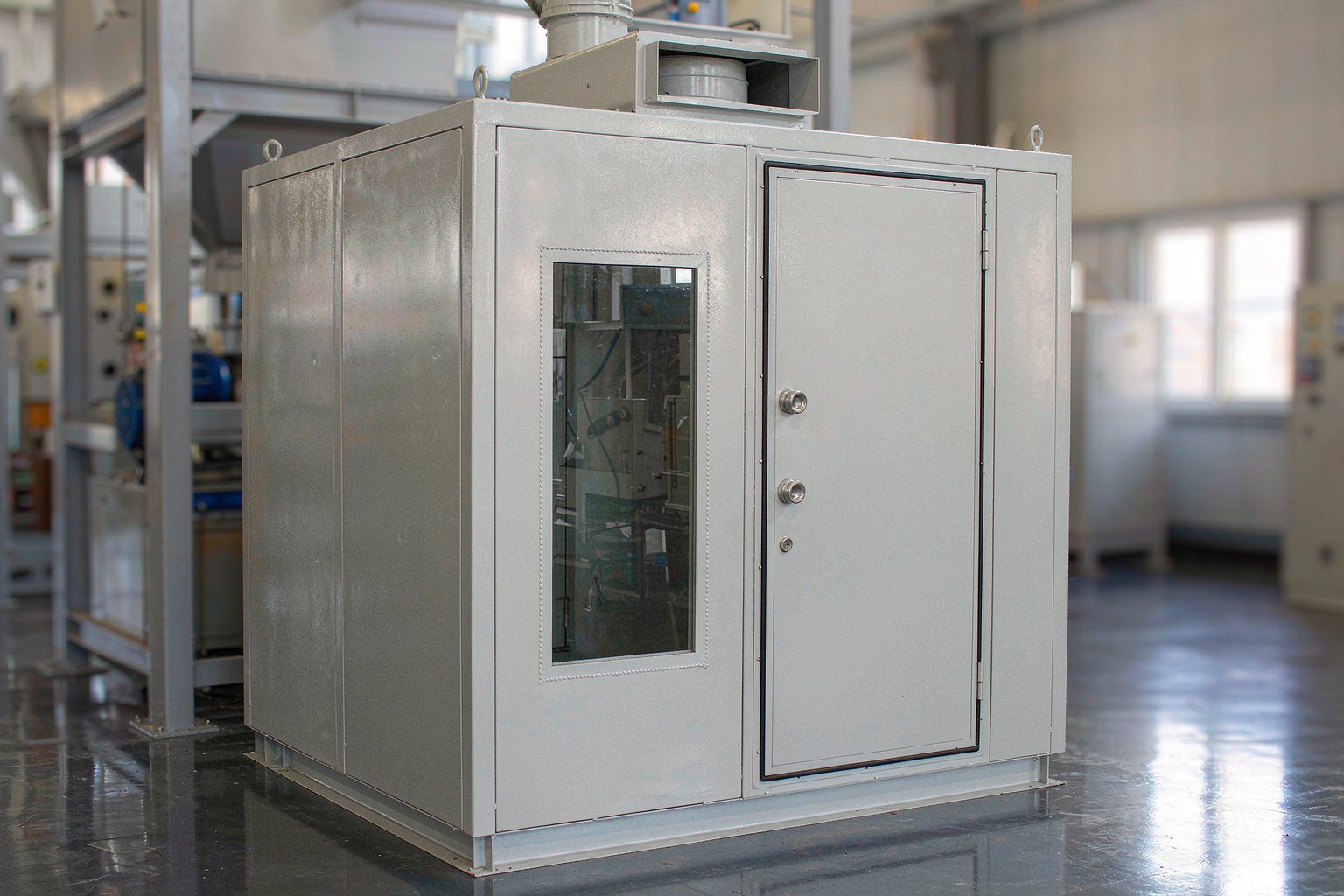
A barrier wall shields the sound path; an enclosure removes the noise where it is born. Fans, air compressors and pumps radiate noise straight from their casings and openings — a wall beside them only blocks part of it. Wrapping the machine in an acoustic enclosure deals with the problem at its origin: a steel skin with enough surface mass blocks the airborne sound, while an absorption layer inside kills the reflections that would otherwise build up in the cavity. The result, measured at 1 m from the enclosure, is an insertion loss of 25~35 dB(A) — a 90 dB(A) compressor drops to conversational level. The engineering, however, is never about the box itself. It is about three accounts that decide whether the enclosure survives its first summer: heat, access and structure-borne vibration. We size all three at proposal stage — bolted modular panels shaped to the equipment, hinged access doors, safety-glass windows, silenced ventilation openings and spring isolators under the base — then verify the result with sound power measurements to GB/T 3768. Send the equipment model, noise level and site photos; we return a sizing proposal the same day.
Panel build-up: mass blocks, wool absorbs
A single steel skin does not make a silencer — sound sets the panel vibrating like a drum head and radiates straight through. Our panels are a four-layer build-up. The outer skin is galvanized steel with electrostatic powder coating; its surface mass sets the baseline transmission loss. The absorption core is 80 mm centrifugal glass wool at 48 kg/m³, NRC ≥ 0.85 — without it, reflections raise the internal sound pressure by more than 10 dB and the real-world performance collapses. The inner face is an acoustically matched perforated galvanized sheet over a glass-cloth membrane: sound enters, fibers stay in. The frame ties the panels into modules with tongue-and-groove joints and sealant, because joints are the one place where performance is decided by workmanship instead of material. The access door is the other critical point: an EPDM gasket compressed by about one third when the door is pulled shut. An enclosure performs exactly as well as its weakest path — panel, door seal or joint — which is why every enclosure is leak-checked joint by joint before dispatch.
Ventilation: sized for the worst-case summer
An enclosure traps heat as efficiently as it traps sound, so the ventilation account comes first. We calculate the airflow demand from the equipment's heat dissipation, size the intake face for low face velocity, and route the discharge through a silenced duct. Internal temperature rise is verified against the equipment's limits at full load in summer — where natural convection is not enough, axial fans are added, each with its own compact silencer. Every ventilation opening is an acoustic leak, so all of them pass through silenced channels lined with the same 80 mm wool: air passes, noise does not. Outdoor units add rain protection — louvered, drained openings and a sloped roof. Heat, noise and rain argue over the same openings; settle the argument at design stage or the machine will settle it for you.
What goes wrong when the details are skipped
Heat sized for nameplate, not for summer. A roots-blower enclosure for a chemical plant was given natural ventilation sized on winter duty; in June the bearing-temperature alarm stopped the machine twice. The retrofit — forced ventilation plus silenced discharge — cost more than half the enclosure. A leaky door seal. One client asked to remove the door gasket for convenience; the noise outside rose 8 dB(A) and no one could find why — a one-metre door gap leaks like several square metres of wall. Missing vibration isolation. A pump-house enclosure achieved only 12 dB(A) until structure-borne vibration through the base was cut with spring isolators and flexible connectors. Airborne sound needs a box; structure-borne sound needs isolation. Both are standard in our supply.
How we size and deliver
Enclosures are quoted by developed panel area, typically 800~1,800 RMB/m² depending on skin material, openings, ventilation and isolation configuration. Installation takes one to two days of equipment downtime: modules bolt together on site, no hot works. Acceptance is by measurement — sound pressure at 1 m, or sound power to GB/T 3768, with the report handed over with the enclosure. Nationwide site survey and installation; hotline +86 18831881133.