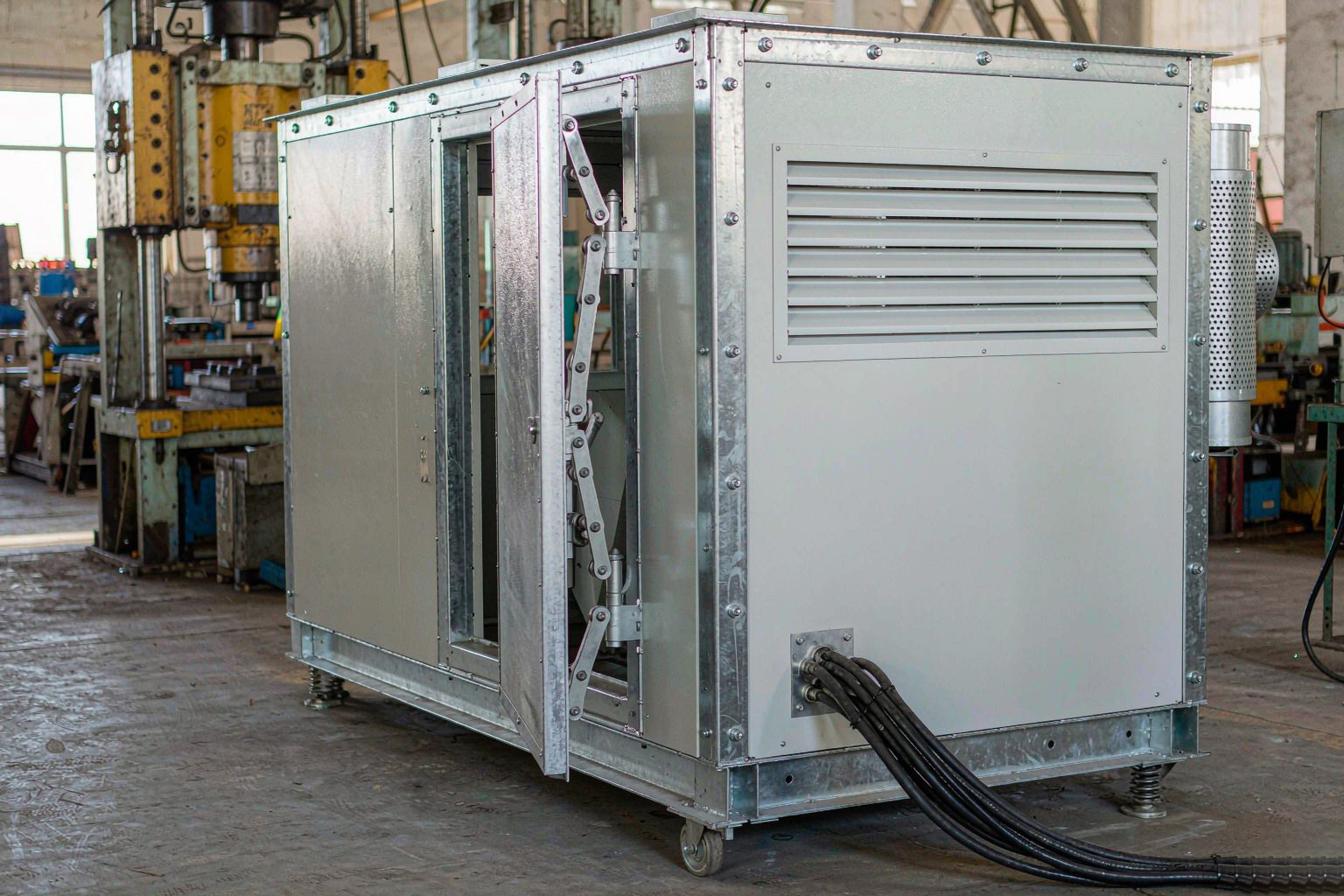
What it is and when to use it. Where a barrier wall stands beside a machine and blocks the sound path, a soundproof enclosure goes one step further — it seals the noise source itself inside a six-sided acoustic shell, so the energy is consumed by the absorptive lining and reflected by the shell, leaving only the ventilation path and seams to leak. It is the most complete single-machine treatment available: 20–30 dB(A) measured at one meter outside, well beyond what an open barrier wall of the same material achieves. HANWEI hoods are modular — the shell arrives as standard panels and assembles on site like building blocks, so any single panel can be opened for service without touching the rest.
Five systems inside one hood. Shell: 2.0 mm galvanized outer plate, 80 mm glass-wool core wrapped in moisture-proof fabric, 1.0 mm perforated inner lining with the perforated face turned toward the machine — inside a closed hood the sound pressure climbs over 10 dB, and only the absorption layer keeps that rise down. Ventilation: heat must leave, so forced intake/exhaust with splitter silencers is sized from the heat load at worst-case summer conditions with 30% margin; the airflow is open, the sound path is not. Access: steel acoustic door with double seals, double-glazed observation window aimed at gauges, hood lighting to the site class. Pass-throughs: every cable, pipe and duct crossing the shell runs through sealed modules — one unsealed 50 mm hole costs 2–3 dB of the whole hood. Vibration: spring or rubber isolators under the base frame stop the machine's vibration from turning the shell into a second loudspeaker — on a punch press project, skipping isolators cost 6 dB against prediction.
Engineering and verification. The hood's real performance is decided by its weakest opening, so we calculate three gates in sequence: shell Rw ≥ 35 dB, total leakage through louvers/seams/pass-throughs, and the internal pressure level with the absorptive lining accounted. Compliance is checked against GB 12348 boundary limits and the 85 dB(A) occupational line where operators stand nearby. Panels are trial-assembled in the factory before shipping, and on site the seam compression is verified with a feeler gauge plus a sound-level-meter walk-around. Maintenance priority is designed in from the start: doors face the daily-service items, the roof over big machines opens in modules for core removal.