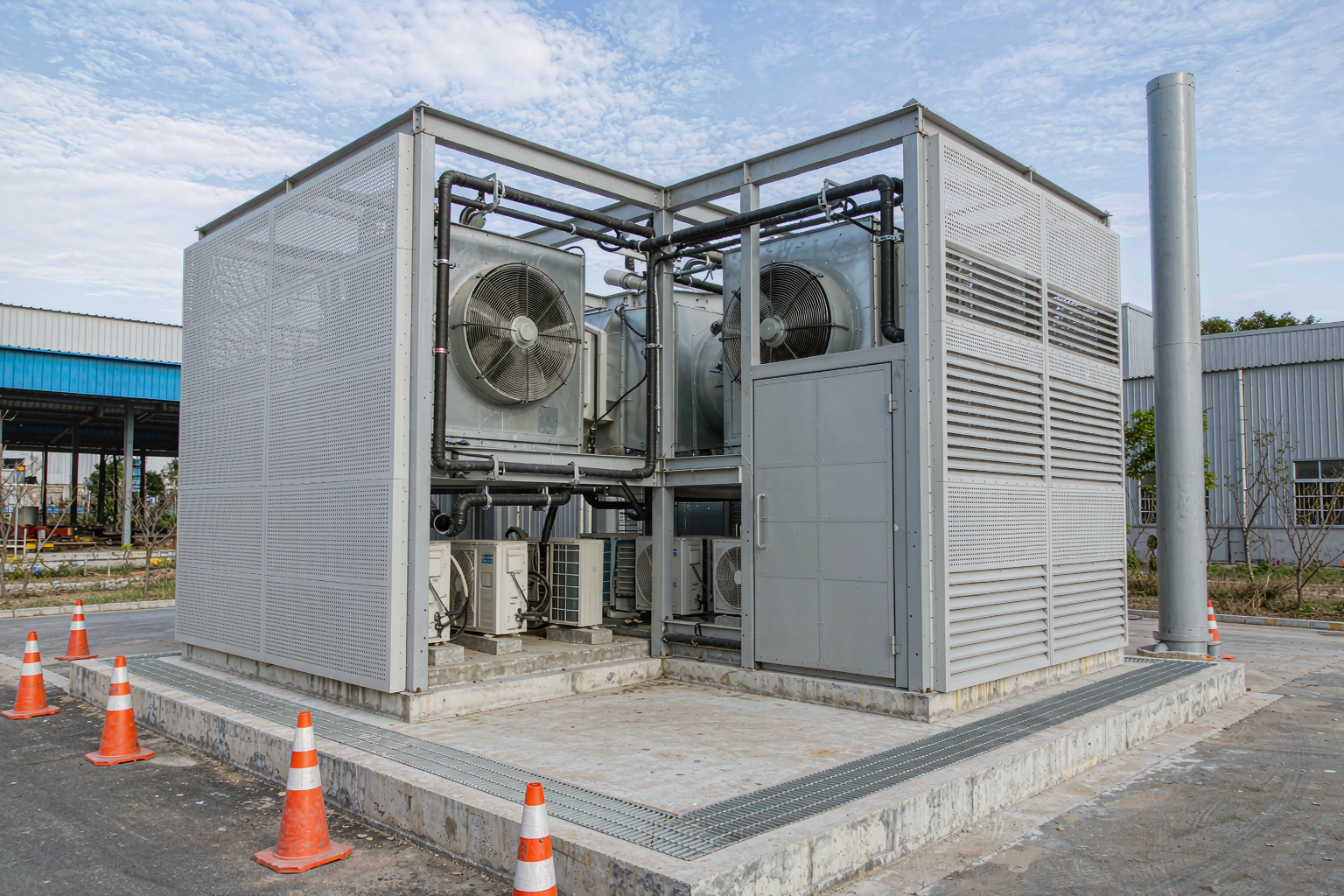
What it is and when to use it. An industrial equipment sound barrier is an absorptive-insulative wall built around or beside high-noise plant equipment — fans, cooling towers, air compressors, punch presses, production lines — to bring the factory boundary back into compliance. Since the Noise Pollution Prevention and Control Law, boundary exceedance is a finable, complaint-driven liability, and this is the workhorse cure. HANWEI equipment barriers achieve Rw ≥ 30 dB with the absorptive face turned toward the machinery (NRC ≥ 0.85), delivering 10–20 dB(A) at the boundary. Heights run 2–6 m — the rule of thumb is one meter above the equipment top, because sound diffracts over the edge. Forms range from a three-side wall to four-side enclosures with roof.
Why the absorptive face must face the machine. Inside a partial enclosure, sound bounces between equipment and wall, and the internal pressure level climbs. A wall that only reflects pushes the internal level up and the leakage out through every opening gets louder — the opposite of the goal. The perforated facing with 80 mm glass wool eats the trapped energy; this single detail separates a genuine equipment barrier from a road barrier re-purposed, and it is the first thing an inspector checks. Ventilation is the second make-or-break part: acoustic louvers (≥15 dB attenuation) keep cooling air flowing while blocking sound, and their area is calculated from the equipment heat load — too small trips the machine in July, too large leaks noise.
Engineering and field lessons. Source diagnosis comes first: we measure each machine's sound pressure level and spectrum, because the true culprit is often one old fan inlet rather than the big new machine, and low-frequency sources need thicker cores plus on-machine treatment (inlet silencers, pipe damping). Boundary limits follow GB 12348-2008 — Class 2 (60 dB day / 50 dB night) or Class 3 (65/55) — with occupational-health 85 dB(A) noted where operators work nearby. On site, maintenance access is agreed with the client's equipment team before drawings (door positions, swing, louver area), bolt torque is marked for annual checks, and third-party insertion-loss testing closes the job — typically 1–2 dB above the design target.