🏭 HANWEI Noise Barriers · Factory Direct Supply 🌐 中文站 📞 +86 18831881133
📞 +86 18831881133Mon–Sun 8:00–20:00 (GMT+8)
Railway Sound Barrier

Railway Sound Barrier

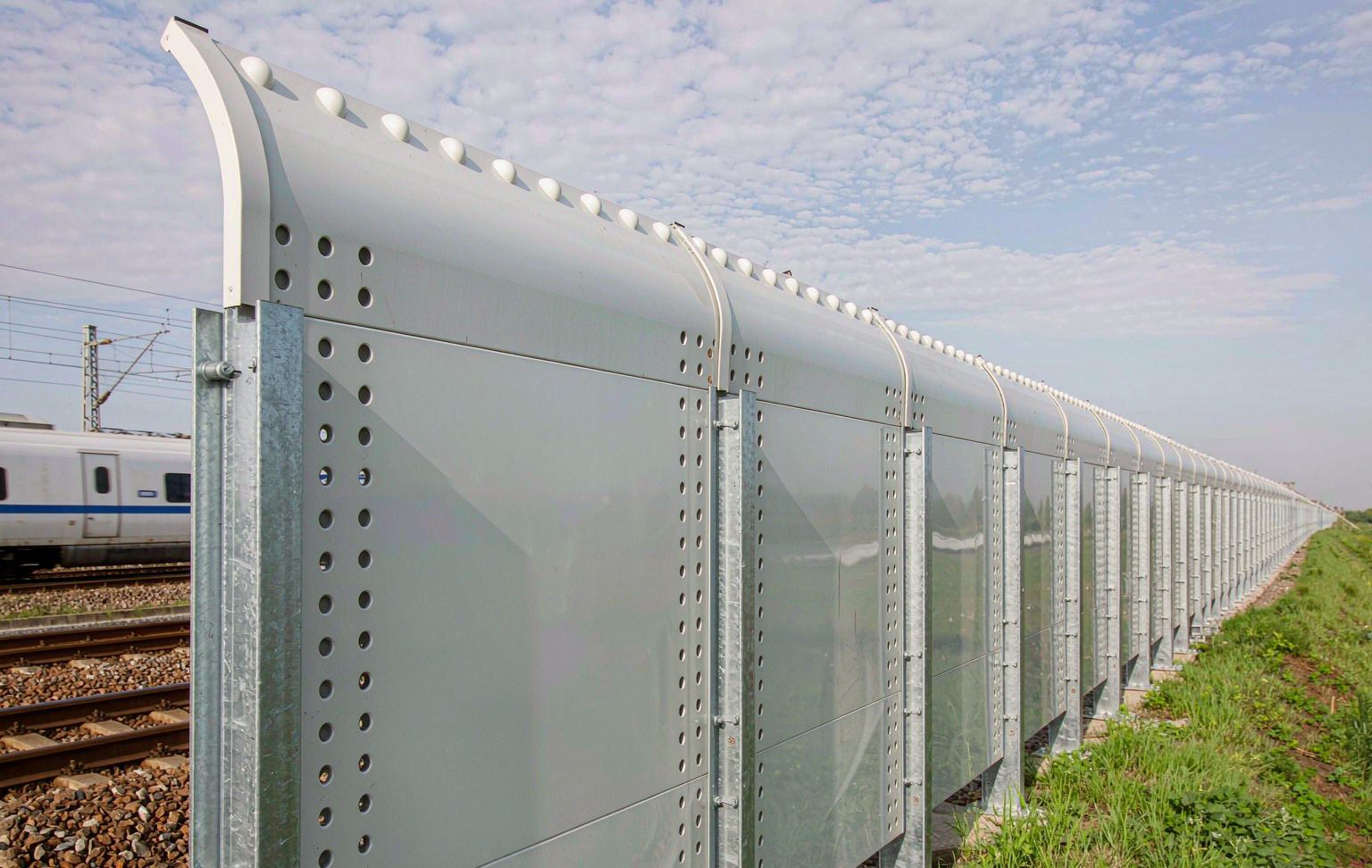
Railway noise barrier engineered for train-induced pulsating wind loads of 0.5–1.2 kPa with fatigue-checked connections. Rw ≥ 30 dB, NRC ≥ 0.85 absorptive core, field insertion loss 10–20 dB(A) on earthwork sections. Suitable for 120–350 km/h conventional, high-speed and intercity lines; bridge-mount and earthwork foundations available.

Factory-direct supply · Custom-built to project specifications

Specifications

Panel height 2.0–3.5 m (up to 5 m for severe points)
Post spacing 2.0 m (standard 2.0 × 1.0 m unit panels)
Posts Hot-dip galvanized H-beam / tube
Acoustic facing 1.0 mm galvanized steel or 1.2 mm perforated aluminum (22–25% perforation)
Sound-absorbing core 80 mm centrifugal glass wool, 48 kg/m³, NRC ≥ 0.85
Sound reduction index Rw ≥ 30 dB
Insertion loss 10–20 dB(A), earthwork sections
Aerodynamic design 0.5–1.2 kPa pulsating train wind, fatigue-checked connections
Corrosion protection Hot-dip galvanizing + polyester coating, 15–20 yr
Applicable lines 120–350 km/h conventional, high-speed, intercity
Foundation Earthwork: embedded/rebar; bridges: ear-plate bolted to parapet
Lead time 7–15 days for first shipment

Product Overview

What it is and when to use it. A railway sound barrier protects residential areas, schools and hospitals along rail lines from train pass-by noise. HANWEI railway barriers achieve Rw ≥ 30 dB with an NRC ≥ 0.85 absorptive core, and earthwork sections routinely measure 10–20 dB(A) insertion loss. Heights run 2.0–3.5 m standard, extendable to 5 m or semi-arc/semi-enclosed forms where the exceedance is severe. The system covers conventional, high-speed and intercity lines from 120 to 350 km/h, with proven post and foundation details for both earthwork and bridge sections.

The railway difference: aerodynamic fatigue. What separates a railway barrier from a road barrier is the train-induced pulsating wind. At 250–350 km/h, a passing train imposes a 0.5–1.2 kPa fluctuating pressure on the panels, cycling hundreds of times a day — a far harsher fatigue environment than any natural wind. Every connection and stopping element in our railway panels is therefore fatigue-checked: hot-dip galvanized H-posts, nylon-insert lock nuts with torque-marked bolts, and rubber stopping strips compressed tight so panels cannot rattle or work loose. This is also why a standard road barrier must never be re-badged for railway use.

Engineering and site practice. Design targets follow GB 3096 Class 4b (70 dB day / 60 dB night) and GB 12525 at the railway boundary; insertion loss is predicted per train type, speed and traffic density before heights are fixed. On site, two lessons from our own projects shape the workflow: first, foundation positions must be coordinated with the four railway services (signalling, communications, power, OCL) at the drawing-review stage — a cable-trough clash we once hit cost a month of rework, so now the four-discipline review is mandatory; second, all trackside work runs inside possession windows, so the programme is planned backwards from daily possession hours. First shipment typically leaves the factory 7–15 days after design approval, with 5,000 ㎡ daily panel capacity behind it.

Frequently Asked Questions

Q: How is a railway barrier different from a highway barrier?

Three differences: fatigue design for train-induced pulsating wind of 0.5–1.2 kPa (road barriers have no such check), possession-window installation planning instead of free access, and Class 4b acceptance limits (70 dB day / 60 dB night). Railway units cost slightly more than road units — roughly 250–550 RMB/m² for standard sections.

Q: Is it safe alongside a 350 km/h line?

Yes, when engineered for it. Our high-speed panels are fatigue-checked against the train wind, posts are hot-dip galvanized H-beams, base bolts are nylon-insert lock nuts with torque marks, and panels are held by compressed rubber stopping strips. Across our completed railway projects since 2019 there has been no panel loosening or detachment; bolt torque is re-checked on every annual visit.

Q: Can transparent sections be used on a railway barrier?

Yes, in stations and urban sections where daylight or sightlines matter — the same 10 mm PC panel as road projects, 88% light transmission, Rw 31 dB. Transparent sections cost more on railways because the clamping must also satisfy the fatigue requirement; we recommend them only where sightlines or station daylight justify it.

Q: How is the noise reduction verified?

By insertion loss — simultaneous before/after measurements at the same point and time period, normally carried out by a third-party lab engaged by the client, with GB 12525 and GB 3096 Class 4b as the compliance limits. Our delivered projects typically measure 1–2 dB above the design target.

Need Railway Sound Barriers for Your Project?

Send your drawings, noise data or site photos — our engineers return an itemized proposal the same day, in English.

Get a Free Quote → 📞 +86 18831881133