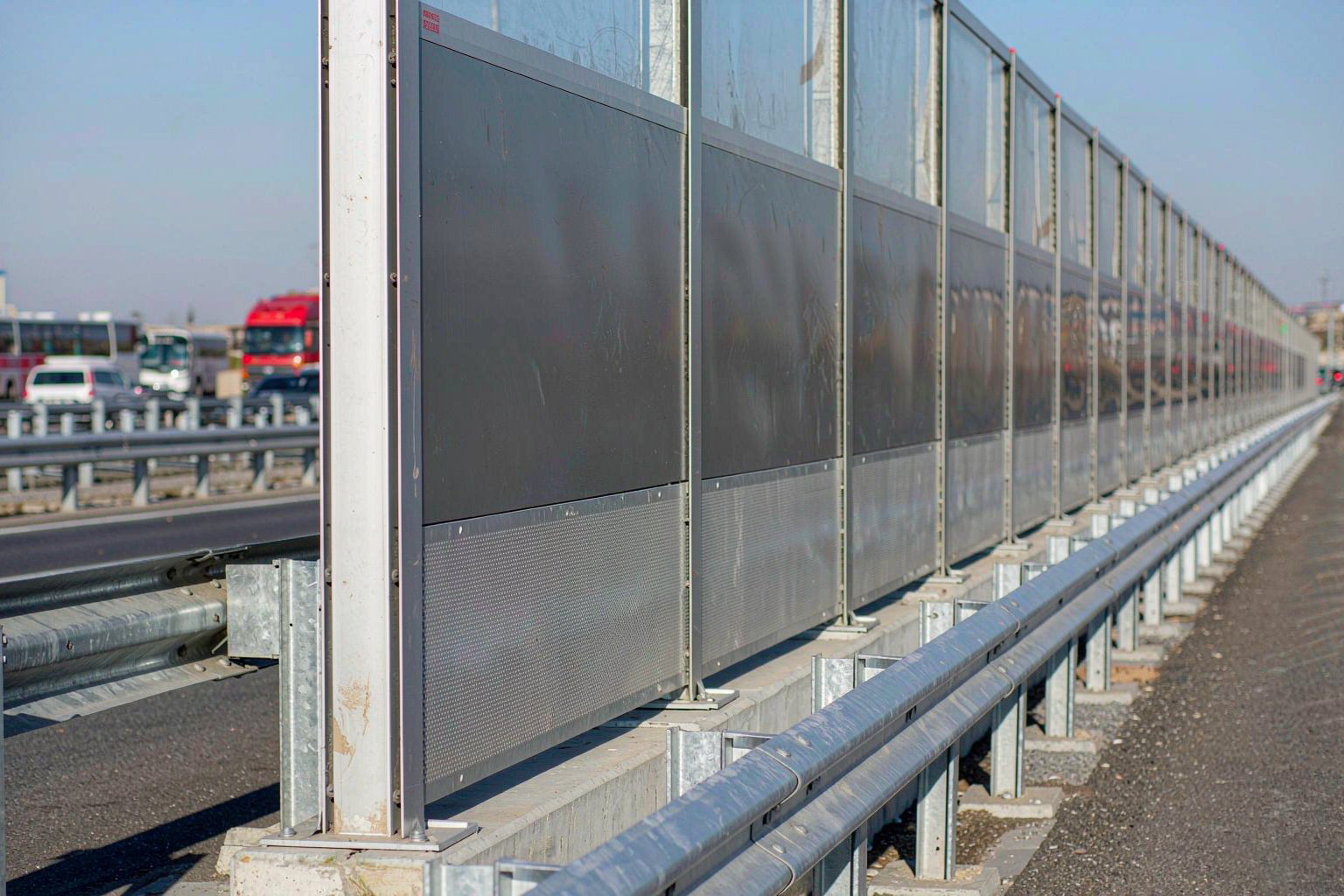
Conclusion first. A highway sound barrier is the standard engineering answer to traffic noise on expressways, urban elevated roads and interchanges — a continuous post-and-panel wall erected between the carriageway and the receivers behind it. HANWEI barrier panels carry a weighted sound reduction index Rw ≥ 30 dB, with an absorptive core of 80 mm centrifugal glass wool (NRC ≥ 0.85), and deliver field-measured insertion losses of 10–25 dB(A) at roadside receivers. Panel heights run from 2 to 8 m: the taller the screen and the closer it stands to the protected buildings, the wider the acoustic shadow it casts. A mid-band of 10 mm transparent polycarbonate (88% light transmission, Rw 31 dB) is available wherever sightlines matter. The system suits new-build expressways, urban retrofits, ramp and interchange sections, and sensitive stretches past residential areas, schools and hospitals. Send us the EIA data or the exceeding monitoring points and our engineers return a preliminary acoustic scheme the same day, followed by an itemized quotation.
Structure and materials. The system is built from four parts. Posts: hot-dip galvanized H-beams at 2.0–2.5 m spacing, sized against the panel height and the 50-year return wind load of the site. Panels: 2.0 × 1.0 m acoustic units inserted between the posts — a 1.0 mm galvanized steel or 1.2 mm perforated aluminum facing (22–25% perforation), an 80 mm glass-wool core at 48 kg/m³ wrapped in water-repellent glass fabric, and a sealed 1.0 mm galvanized back plate. The perforated, absorptive face must point toward the traffic: a barrier that only reflects sends sound bouncing back into the road corridor and re-radiates it past the screen ends, so on sensitive stretches we engineer a 30–60% absorptive panel ratio instead of running reflective plate all the way. Transparent sections: 10 mm UV-co-extruded polycarbonate in aluminum clamping profiles, placed at curves, ramps and daylight-sensitive stretches. Foundation: pile caps or reinforced concrete footings per the soil report, with base flanges bolted by nylon-insert lock nuts carrying painted torque marks. Three checks apply to every batch — the rubber stopping strips between panel and post must compress tight (loose strips rattle audibly at traffic speed), the wool must fill the cavity without voids, and every site cut must be touch-up painted, because a severed galvanized edge is the only place this system ever rusts.
Engineering basis. Design targets follow GB 3096 Class 4a (70 dB day / 55 dB night at the roadside facade) or the project EIA, whichever is stricter. We model traffic noise from vehicle volume, heavy-vehicle percentage, speed and road geometry, subtract the natural attenuation of the intervening ground, and back-calculate the insertion loss the barrier must deliver at every receiver — then choose the panel height from the floor distribution of the buildings behind it, not from habit. This is where honest engineering matters: raising a screen by 0.5 m typically buys 1–1.5 dB at upper floors while the steel and foundation costs jump, so the prediction sheet, not a negotiation, decides the height. Curves and ramps get transparent sections for sightlines; bridge sections get lighter panels with ear-plate connections to the parapet; drainage holes at the panel base prevent water trapping behind the wall.
Field experience. Three lessons from completed projects shape how we build today. First, panel rattling: barriers whose stopping strips were under-compressed developed an audible ticking in the wind gap at traffic speed — the fix is specifying the strip compression and checking it panel by panel at acceptance, not discovering it from complaints. Second, absorptive ratio: on one urban canyon stretch a fully reflective wall was later retrofitted with absorptive panels because the reflected component kept facade levels high even though the direct path was blocked — since then we default to absorptive sections wherever receivers sit within roughly 50 m of a parallel wall or cutting. Third, maintenance reality: perforated faces collect dust and brake residue, and two or three dirty years can block a fifth of the open area — plain-water washing every one to two years keeps the insertion loss on design values, which is why a cleaning schedule is handed over with the acceptance documents.
Custom engineering and export service. Every barrier is produced to the project, not pulled from a catalog: panel heights, absorptive ratios, post sections, colors and transparent-band positions are all configurable, and non-standard panel sizes are manufactured to the framing grid of the design drawings. For export projects we provide the full English documentation set — general arrangement drawings, material certificates, coating-thickness reports and packing lists — and sea-worthy packaging with panel-edge protection. OEM branding on posts and panels is available for distributors. Whether the site is a mountain expressway, a coastal viaduct or a desert corridor, the wind-load, corrosion and seismic parameters of the scheme are adapted to the local codes, and the same engineering team that produced the prediction sheet follows the project through to handover.
Supply, installation and service life. Our production lines run 5,000 ㎡ of panels per day, so the first shipment typically leaves the factory 7–15 days after drawing approval, with posts and fasteners packed per section for sequenced unloading along the live road. Panels are trial-assembled before dispatch; installation proceeds section by section under the traffic-management plan, with post verticality, strip compression and bolt torque checked against a checklist that stays with the handover file. The galvanized-and-coated system is designed for 15–20 years outdoors with no scheduled maintenance beyond inspection and periodic washing; any damaged panel is a single-unit swap thanks to the insert-type design, and the torque marks make bolt loosening visible from the ground during annual walks. Third-party insertion-loss testing at handover closes the job, with the measured values filed against the design predictions.