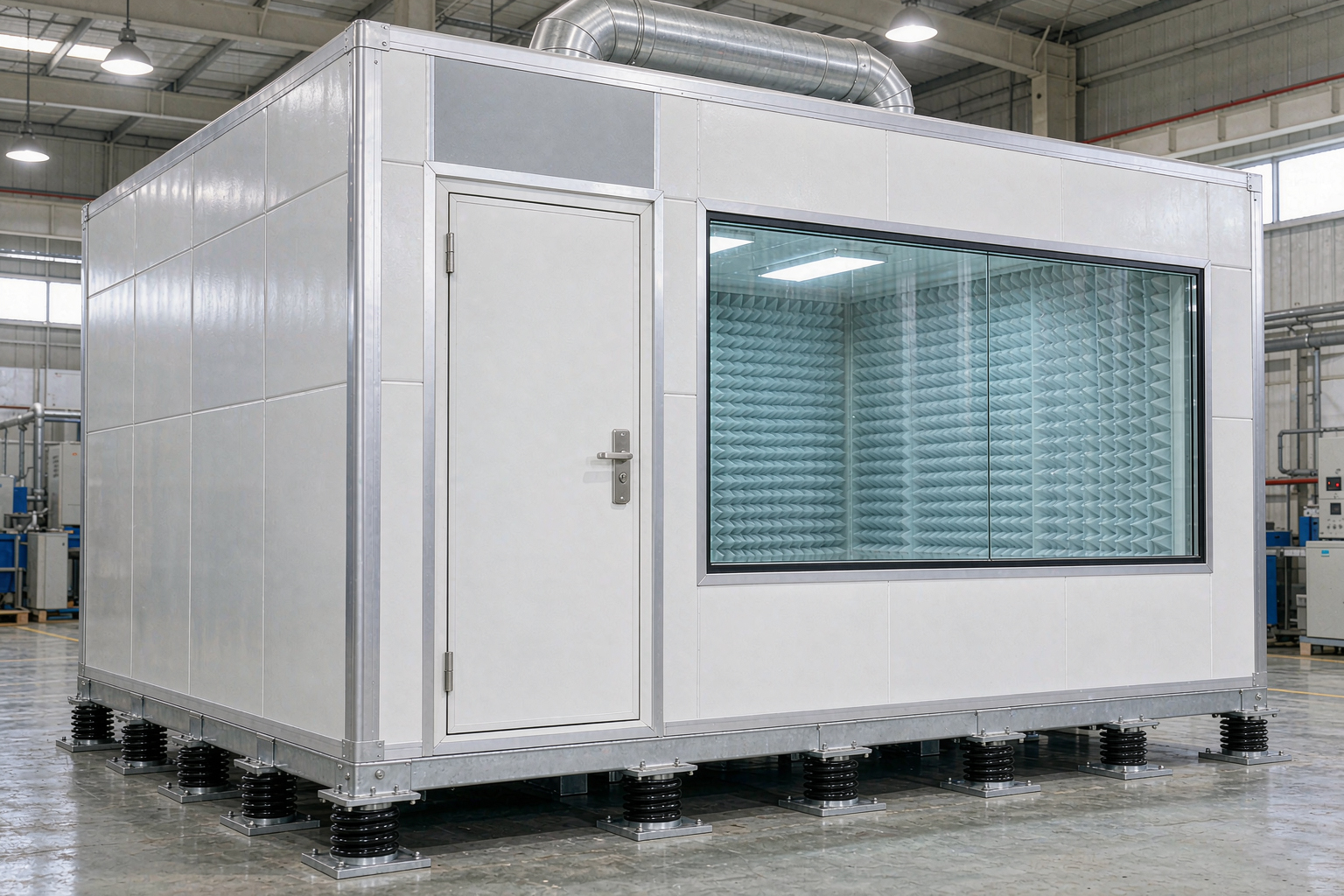
Conclusion first. A sound test chamber — also called an anechoic chamber or quiet room — differs from an ordinary acoustic enclosure in one decisive way: an enclosure keeps outside noise out, while a chamber must also make inside sound disappear, because the work performed inside — acoustic testing, precision inspection, hearing screening — is itself sensitive to background sound. The metric that matters is therefore not "how many decibels were reduced" but the indoor background noise level: below 35 dB(A) for quiet offices and listening tasks, below 25 dB(A) for product acoustic testing, and down to 15 dB(A) for quasi-semi-anechoic work. HANWEI chambers are built as room-in-room structures: the inner room floats on damped spring isolators with a natural frequency at or below 5 Hz to cut structure-borne sound, double composite wall panels reach Rw ≥ 45 dB against airborne noise, and interior faces are fully lined with 80 mm centrifugal glass wool (48 kg/m³, NRC ≥ 0.85), compressing reverberation time below 0.3 seconds. Quiet background, short reverberation, no vibration — all three at once, or it does not deserve the name. Send the test object and target background level; the combined scheme comes back the same day.
Three leak paths decide success or failure. A chamber never fails on its walls — it fails in the details. Vibration first: structure-borne sound from floors and slips bypasses any acoustic wall; footsteps, overhead cranes and a neighboring machine's start-up all travel the building frame straight into the room and lift the background floor. So the floating room-in-room frame and ≤5 Hz springs are standard, never options, with an independent foundation where slab loading is short. Ventilation second: people work inside for hours, so fresh air must run continuously — and a duct is a straight acoustic bridge. Supply and extract both pass through silencers in series, duct velocity is held under 3 m/s, outlet self-noise stays ≤30 dB(A), and the air-handling unit hangs on spring mounts, so the chamber breathes silently. Penetrations third: every power, signal or sprinkler pipe through a wall is a leak until proven otherwise — all services cross through sealed acoustic boxes, lighting is low-noise LED, the door is an Rw ≥ 40 dB acoustic model with double seals and compression latches, and the window uses unequal-thickness double glazing to stagger coincidence dips. Only when all three paths are sealed does a background-noise measurement mean anything.
The material bill: insulation and absorption are two separate purchases. Isolation comes from panel mass and airtightness; absorption comes from the interior lining. Standard rooms line the walls and ceiling with 80 mm centrifugal glass wool behind perforated facings — mid–high absorption is strong and reverberation drops below 0.3 seconds, right for listening tests, fault diagnosis and small-object testing. For quasi-semi-anechoic work — measuring the sound power of a whole machine or locating noise sources — flat absorbers are not enough: the upgrade is glass-wool wedges, rows of tapered absorbers covering five surfaces, normal-incidence absorption ≥ 0.99, cut-off frequency 100–250 Hz selected by wedge length, with a strong reflective floor and walking grid preserving the semi-free field. We use the centrifugal glass-wool system throughout for its documented density, fire and moisture behavior, with hydrophobic facing where humidity demands it. The budget concentrates in structure and doors, but the performance floor is set by these invisible details — which is why every chamber ships with a measured background-noise report.
Field lessons. A rigid connection doubles the floor: on one product-test chamber the exhaust duct support rested directly on the workshop slab — at night, when the neighboring machines started, the background jumped from 24 to 38 dB(A) and every test was wasted. Reworking all services onto the inner frame with full structural separation brought the floor back to 25 dB(A); since then a separation check with photo records is a fixed acceptance item. Ventilation without silencing fails people first: a hearing-screening room met its noise floor but the duct roar made subjects report a background hiss and corrupted results — two silencer stages and lower duct velocity brought outlet noise under 30 dB(A). A chamber is not about being as quiet as possible; it is about being quiet and usable. Door-seal leakage stalls acceptance: a 25 dB(A) room measuring 27 dB(A) for three days turned out to have an under-compressed bottom seal. The door is the weakest link — double seals, compression latches and a drop seal are all mandatory, and we bench-test every door before shipment and re-measure the whole room on site, data written into the acceptance sheet.
Three grades, three budgets. The 35 dB(A) quiet-room grade: composite panels, absorptive lining, standard acoustic door and window, single-stage silenced ventilation — right for quiet offices, streaming and recording, and equipment listening, at the lowest outlay. The 25 dB(A) product-test grade: thicker walls, tighter doors, two-stage silenced ventilation and upgraded springs — the mainstream choice for factory acoustic inspection of motors, appliances and hardware. The 15 dB(A) quasi-semi-anechoic grade: full wedges, independent foundation or full floating, fully silenced air-conditioning — roughly twice the test-grade investment, for sound-power and source-location work. Three pieces of advice: pick the grade backward from the test standard, not from instinct; within a grade, spend first on door sealing and ventilation silencing, where failures are most common; and measure site vibration before fixing a grade — forcing a top-grade chamber onto a vibrating slab wastes money, and our survey says so honestly at proposal stage.
Verification and supply. Four checks before signing: demand third-party measured background-noise reports from delivered projects — design values count for nothing; confirm the vibration-isolation scheme (room-in-room, spring frequency, slab-load calculation — all three, not one); audit the ventilation chapter separately (air volume, duct velocity, silencer stages, outlet noise limit); and for wedge chambers ask for the cut-off frequency against your lowest test band, because an absorption figure without a frequency is meaningless. Production runs 20–35 days with factory-numbered modules; assembly follows a fixed sequence — base frame and springs, modules, sealed service boxes, finishing — and acceptance closes with octave-band background-noise measurement, reverberation time and a ventilation re-check, the full report delivered with the room.