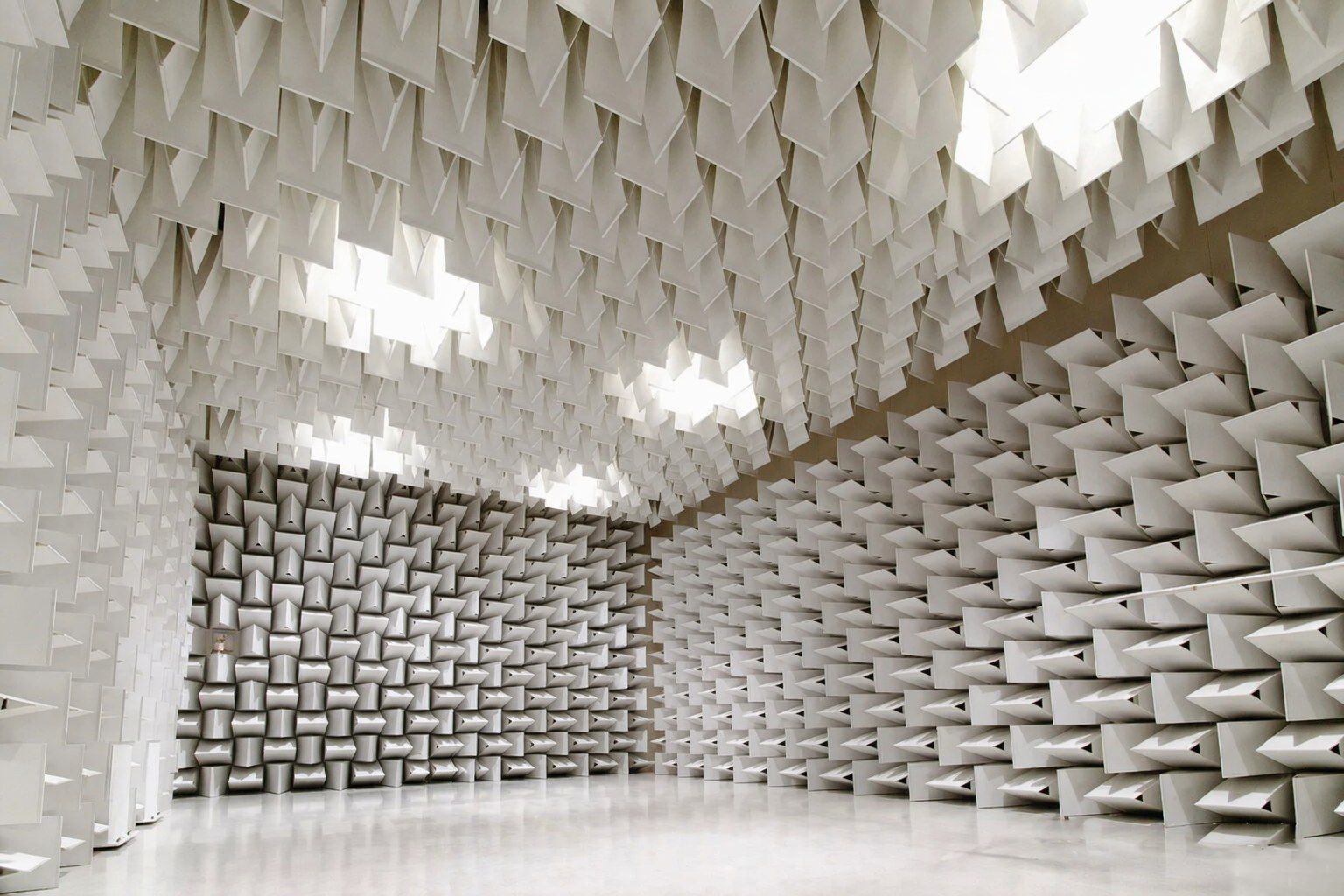
Acoustic Wedges: Turning a Room Into an "Echo-Free Zone"
Why are measurements in ordinary rooms unreliable? Because reflected sound from walls and ceilings mixes with the direct sound, and the microphone always picks up the original source plus a long trail of echoes. A reverberation-free chamber has only one job:make sound waves go in and never come out—and that is exactly what acoustic wedges accomplish. Conventional flat absorbers handle mid-to-high frequencies well, but low-frequency sound waves with wavelengths of two or three meters are essentially invisible to flat materials. The cleverness of wedges lies in their impedance gradient:from tip to base, the exposed depth of the absorptive material changes continuously, so incoming sound waves do not encounter an abrupt boundarybut are gradually guided into the tapered cavity and dissipated layer by layer with minimal reflection. Achieving a normal-incidence absorption coefficient above 0.99—consuming 99% of incident sound energy—requires matching the wedge length to the wavelength of the target lowest frequency: targeting 100 Hz means the total depth (wedge plus air cavity) must exceed one meter. Hanwei Noise Control designs its wedges backwards from the acoustic field requirement: your target free-field cutoff frequency, the net test-space dimensions, and the floor-load capacity—these three parameters determine the wedge length, installation method, and structural design, with a full design review before production begins. Call 18831881133.
Wedge Length vs. Cutoff Frequency: This Determines Your Biggest Cost
More than half the cost of an anechoic chamber goes into the wedges and their mounting system, and wedge quantity is dictated by the cutoff frequency.The lower the cutoff frequency, the longer the wedges, the more floor space the effective room consumes, and the higher the cost climbs: a 250 Hz cutoff needs roughly 600 mm wedges—suitable for household appliances and small electroacoustic products; 125 Hz calls for 800–1000 mm wedges; for automotive assemblies or engine sources, which produce high acoustic energy at low frequencies, a cutoff of 80–100 Hz requires wedges starting at 1000–1200 mm plus a sound-isolating, vibration-dampened housing. The most common mistake is copying someone else's wedge length: a neighbor's lab may succeed with 600 mm wedges for small appliances, but using the same length to test a refrigerator compressor will fail to absorb low frequencies, and test data will drift at the lower frequency limit. Our approach starts with a simple question—what is the lowest发声频率 of the DUT? That is the primary determinant of wedge length, followed by the balance between room size and budget.
Core Material & Facing: How We Maintain a 0.99 Coefficient
The absorption performance of a wedge is summarized on a spec sheet in a single line, but three process gates lie behind that number.First is the density and uniformity of the fiberglass: the core uses continuous centrifugal glass wool (density 48 kg/m³, NRC ≥ 0.85). Non-uniform filling produces inconsistent performance across each panel on the same wall, directly violating acoustic field uniformity standards. Our trapezoidal cores are pressure-formed in a single mold, with batch-to-batch dimensional tolerance of ±3 mm, ensuring acoustic consistency across the entire array.Second is the breathability of the facing: the glass wool needs a facing to prevent fiber shedding, but an overly dense facing will reflect high frequencies back into the room. We use a dual-layer construction of fiberglass cloth plus perforated facing, with the perforation rate designed for acoustic impedance matching—keeping the wool contained while letting sound pass through.Third is the concealment of the frame: metal keel and frames are hard reflective surfaces; improper placement leaves reflection hot spots in the acoustic field. Our hanging system hides the frame in the shadow zone behind the wedge body, so sound waves strike wool, not steel. At acceptance, we perform a free-field certification per ISO 3745, measuring deviation point by point—delivery occurs only when data meets the standard.
Floor Grid & Walkway: How to "Walk on" the Floor Wedges Without Damage
A fully-anechoic chamber's floor is entirely covered with wedges, yet personnel, test articles, and transfer carts must enter. The solution is theacoustic floor grid: a load-bearing steel wire mesh supported above the floor wedges, acoustically transparent (high open-area ratio, no measurable reflection) yet structurally capable of supporting foot traffic and small carts. The grid height determines the length of the "floor reflection path," calculated together with the wedge length—too high wastes space, too low allows floor reflections to re-enter the free-field zone. Doors for test-article access and hoisting openings are reserved on the installation drawing. Wedge panels in the test area are designed as removable modules: during large-equipment hoisting, local wedges are taken down and reinstalled after positioning. A semi-anechoic chamber (retaining a hard floor surface) is an alternative route: the floor uses epoxy coating without wedges, which is better suited for tests where the sound source sits near the floor, such as automotive chassis dynamometer or whole-unit sound-power measurements. Whether you choose full or semi anechoic depends on whether the DUT requires a "grounded" simulation condition—we calculate this trade-off during the proposal stage.
Sound-Insulating Enclosure & Background Noise: An Anechoic Chamber Is Never Just About the Wedges
Many first-time clients assume purchasing wedges equals purchasing an anechoic chamber—wedges only absorb sound inside the room; they cannot block outside noise from entering. The laboratory's background noise is an independent hard requirement: overhead cranes in the factory, air compressors, and highway trucks all transmit vibration through walls and floor slabs into the room. When background noise is high, low-level testing becomes impossible. A qualified anechoic chamber is therefore a "three-piece set": a sound-insulating enclosure (insulated walls and doors, blocking external airborne sound), a vibration-isolated floating system (spring or rubber isolators cutting structure-borne transmission), and absorbing wedges (building a free-field environment indoors). These three components each claim a share of the budget—omitting any one creates a fatal gap. Without insulation, only wedges, background noise swamps the signal during low-power equipment testing; without vibration isolation, equipment running downstairs makes the room "hum." Our project process begins with on-site background-noise and vibration surveys, then defines what each of the three pieces must achieve—first assess how loud the environment is, then determine the quietest sound level to be measured—the difference between the two defines the budget structure, laid out transparently during the proposal stage.
Scenario Quick-Reference: Four Types of Laboratories
Automotive NVH Laboratory: whole-vehicle or assembly sound-power and transfer-path testing, mostly semi-anechoic, cutoff frequency 80–100 Hz, wedge length 1000–1200 mm, paired with a chassis-dynamometer floor grid and crane.Home Appliance / Motor Testing: whole-unit sound-power calibration, semi- or fully-anechoic, cutoff frequency 125–250 Hz, wedge length 600–1000 mm.Electroacoustic / Loudspeaker Testing: small-space, high-requirement setups, primarily full anechoic, cutoff frequency matched to the lowest test band, paired with a test floor grid and electromagnetic shielding.University & Research Institutions: multi-purpose small-scale chambers, wedges matched to primary research bands, often with a removable floor grid to support dual-mode operation. The common thread across all four scenarios is this:wedge length follows the test lower limit, installation layout follows the DUT—define the test mission first, then size the engineering configuration.
Purchasing Pitfall Avoidance: Four Verification Actions for Wedge Proposals
1. Check the frequency lower limit in the test report. A proposal that quotes "absorption coefficient 0.99" without stating the cutoff frequency is meaningless—0.99 is calculated from the cutoff upward; a wedge whose coefficient drops to 0.5 below 100 Hz can still legitimately carry that same number.
2. Verify core uniformity. Request dimensional tolerance and filling-process documentation for each batch. If possible, randomly select two panels from the array and compare them directly—mixing non-uniform wedges into an array will cause the acoustic field uniformity certification to fail.
3. Inspect facing breathability and fire rating. The facing perforation rate and acoustic-impedance matching are critical to high-frequency performance. The fire-rating等级 of the core and facing must be written into the contract (Class B1 or above)—laboratories are long-term enclosed working spaces, and this item admits no compromise.
4. Write field certification into the acceptance criteria. The contract acceptance standard should read "free-field certification per ISO 3745, deviation values within tolerance," not "receive goods at warehouse"—wedges that fail to deliver the certified acoustic field are scrap metal, regardless of price.
Supply & Installation Process
1. Acoustic Design: Collect test mission, DUT lowest frequency, room civil-drawing dimensions, floor-grid and hoisting requirements in one session;
2. Proposal & Quotation: Provide separate line-item pricing for wedge length and layout drawing, cutoff-frequency commitment, keel-hanging system, and sound-insulating, vibration-isolating housing recommendations;
3. Detailed Design: Wedge-panel segmentation drawings, frame节点 details, floor-grid structure and load calculations, door openings and hoisting-orifice reservations;
4. Production: Trapezoidal-core pressure-forming and filling, dual-layer facing application, frame-unit assembly, batch uniformity spot-check;
5. On-site Installation: Keel hanging, wedge-array installation, floor-grid erection, seam and end-finishing;
6. Acceptance: ISO 3745 free-field certification (point-by-point deviation measurement) + background-noise re-check, with the certification report delivered in the project file.