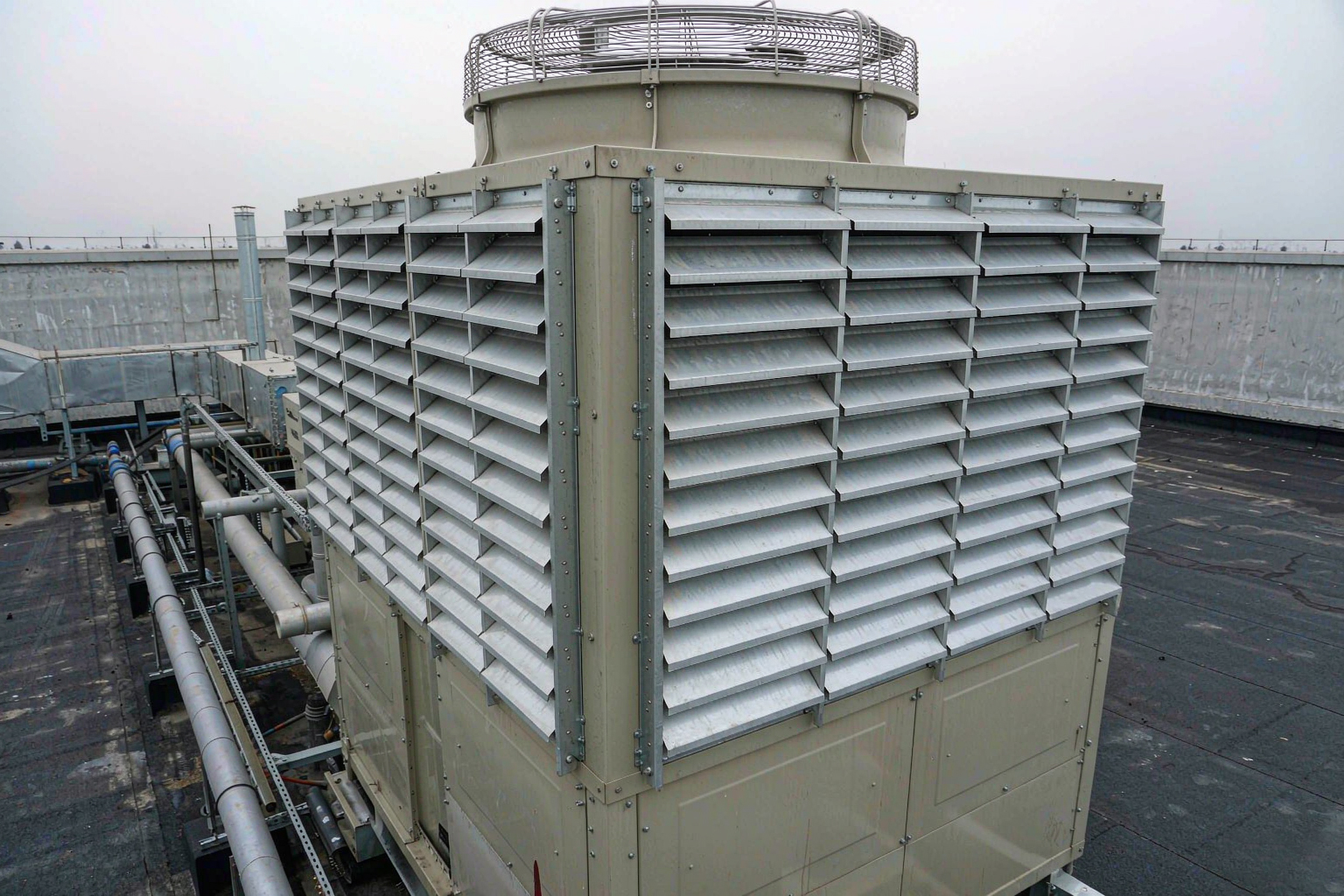
Conclusion first. Every cooling tower already has louvers on its intake face and top discharge — a plain rain louver lets air in and keeps rain out, but it lets noise out just as freely. A HANWEI ventilation acoustic louvre turns that mandatory fitting into a silencer: the same free ventilation area, the same rain performance, plus a dynamic insertion loss of 10–18 dB(A). The blade is an inclined, interlocking hollow section filled with 80 mm centrifugal glass wool (48 kg/m³, NRC ≥ 0.85); air folds through the blade gaps while sound is absorbed at every bend behind the perforated facing, and the interlocking water-deflecting edges keep the rain performance intact. On towers already fitted with a barrier, the louvre closes the last direct path at the top discharge and intake openings; on towers without a barrier it alone takes a large bite out of the splash and airflow noise. Send the tower model and opening dimensions — the combined airflow-and-acoustics calculation comes back the same day.
Design core: not one square meter of airflow may be lost. A silencing louvre is still a louver first. Filled blades and folded flow paths add resistance by nature, so the whole design effort goes into pushing that resistance back down to plain-louver levels. Three rules: the free ventilation area stays at ≥50% of the opening — the same as a plain rain louver — or the opening is enlarged; blade angle and spacing are sized to the rated airflow with the face velocity held at or below 6 m/s, because beyond that the regenerated noise of the air itself can drown out the attenuation (the classic reason cheap louvers "make it louder"); and every set ships with measured pressure-loss data, ≤30 Pa at rating, comfortably inside the tower fan's static-pressure margin. On the acoustic side, the inclined interlock forces sound to fold at least twice between blades, and every fold lands in absorptive wool — mid–high frequency insertion loss clears 10 dB easily, stacking further on top of an intake-face barrier.
The material bill this position cannot skip. Louvers around a cooling tower work in a harsher environment than any barrier — water mist lands directly on the blades and water-treatment chemicals crystallize on every surface. Ordinary galvanized steel louvers seize with rust in two or three years. Our standard is fluorocarbon-coated aluminum blades on an aluminum lattice with stainless fasteners, the wool wrapped in a double waterproof membrane behind a perforated aluminum facing, and drainage gaps at the blade base so condensate runs out by gravity. A chemical plant we served had run ordinary steel rain louvers for four years — blades rusted through, wool collapsed, noise crept back and complaints followed. The replacement acoustic louvre measured a 14 dB insertion loss at the intake face, and a blade swap for inspection took half an hour. The material premium is about a hundred RMB per square meter; the service-life gap is more than threefold.
Field lessons. Blades fitted backwards: on a data-center rooftop the installing crew reversed the tilt — deflecting edges facing inward, absorptive faces outward. Rain ran into the basin, diluted the water-treatment chemistry, and the dosing contractor called first. Acoustic louvers are directional: weather face, flow angle and drainage gaps all have a correct orientation, so every set ships with a direction diagram and the site briefing walks through it blade row by blade row. Unwrapped wool: low bids save cost by filling the cavity bare — in tower mist, bare wool cakes within two years and loses half its absorption while the louver looks perfectly fine. The acceptance check is to open one blade and verify three layers — waterproof membrane, hydrophobic glass cloth, perforated facing — and that check is printed on our factory inspection sheet. Sized without airflow calculation: fitting silencing louvers wall-to-wall by opening size alone, without free-area and pressure-loss checks, quietly transfers the cooling risk to the owner, who then blames "bad louvers" for higher chiller power. Our proposals always carry two calculation books — acoustics and airflow — and if the pressure loss would eat the fan margin, we enlarge the opening or drop a blade row rather than let the tower struggle.
Where it fits and how it combines. Intake face: a direct dimensional replacement for the original rain louvers, respecting the tower's intake-standoff requirements — on barrier-equipped towers the intake is the breathing throat, so the free area ratio of ≥50% is non-negotiable. Top discharge: acoustic louvers or a directional attenuating bend above the fan outlet handle the low-frequency hum best and double as rain protection. Machine-room openings: fresh-air inlets of tower floors and intake/exhaust of generator rooms use the same module, adding room-level attenuation. With barriers: the barrier handles diffraction paths, the louvre handles the direct openings — the two cover different noise paths, and in a combined design the louvre's attenuation is credited against the barrier budget so nothing is bought twice.
Verification and supply. Four checks before signing: demand pressure-loss figures (a scheme without them is eliminated on sight); open a sample blade and confirm the three-layer build — membrane, glass cloth, facing — because batches are open to the same spot check; compute the free-area ratio (below 45–50% means enlarge the opening or cut a blade row, never force-fit); and inspect the blade cross-section for even wool fill and bonded facings, where the cost difference between serious and cheap products is visible at a glance. Production runs 10–20 days with direction diagrams and inspection sheets per batch; acceptance closes with an insertion-loss measurement at the opening plus a fan-current re-check — one visit proving the noise came down and the airflow did not.