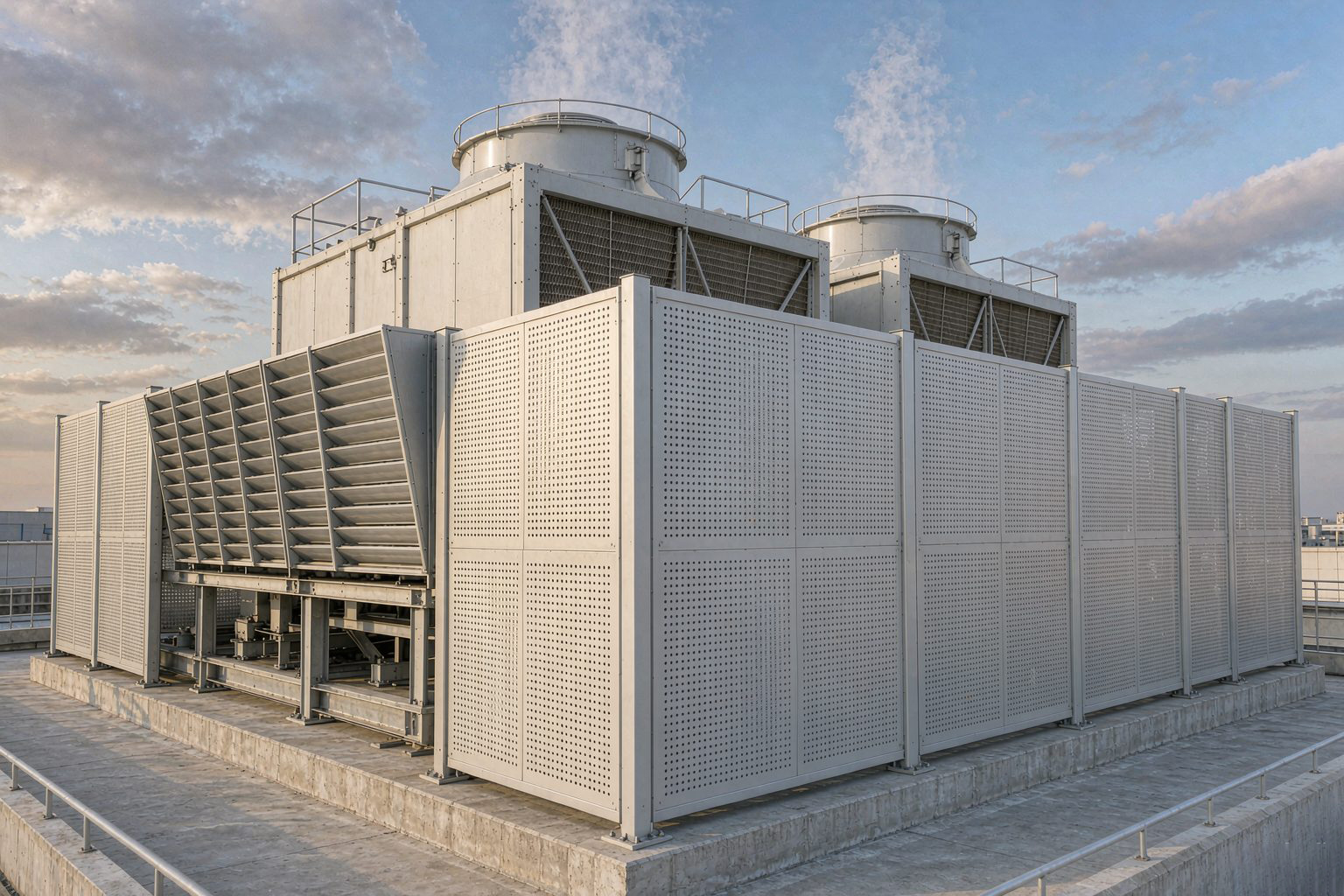
Cooling Tower Sound Barrier: Protect Cooling First, Then Talk About Noise Reduction
Cooling towers are the most "delicate" of all noise-control targets — they are equipment that works by drawing in air, so noise treatment must be based on the principle that "not a single cubic meter of air can be lost." Cooling tower noise has three sources: the low-frequency "hum" of the top fan blades (travels farthest, main source of complaints), the mid-high frequency "splash" of water falling into the collection basin (loudest nearby), and the mechanical noise of the motor and drive mechanism. Hanwei's cooling tower sound barriers are designed on the principle of "enclosing without blocking": sound-absorbing and insulating panels made of perforated aluminum or galvanized steel (filled with 80mm centrifugal glass wool, NRC≥0.85, Rw≥30dB) are installed around the tower body, with the air-intake face opening rate maintained above 30%. The barrier is kept at a safe distance from the tower's air-intake face, and silencing louvers are added at the top as needed. Measured noise reduction at sensitive points: 8–18 dB. The hot-humid environment with water mist is a severe test for materials, so we default to aluminum panels with fluorocarbon coating — no rust-through for 15–20 years. Send us the tower model, location, and exceedance points, and we'll provide a combined "air-intake + noise reduction" calculation the same day. Phone: 18831881133.
Design Red Line: Blocked Air Intake Means Cooling Failure
There is only one red line in cooling tower sound barrier design: the air-intake face must never be smothered by the barrier. Cooling towers rely on fans to draw air to cool circulating water. Insufficient air intake directly raises the outlet water temperature and reduces chiller efficiency — you might save yourself from noise complaints, but you'll pay for it with poor air conditioning performance. That's why our design process includes an extra step of "combined calculation": first, we calculate the air-intake requirement based on the tower's nameplate airflow; then we determine the distance between the barrier and the tower's air-intake face (generally no less than 0.5–1 times the intake height), the opening rate of the intake face (≥30%), and the airflow resistance of the openings. Only when all three are satisfied do we move on to acoustic configuration. Materials are also selected for this environment: the area around the tower is hot, humid, and misty year-round. Ordinary galvanized steel shows rust spots within three years. We default to perforated aluminum panels with fluorocarbon coating. The sound-absorbing wool is wrapped in double-layer waterproof film and covered with an aluminum perforated protective facing. A drainage channel at the bottom directs condensate and splash water away — once wool absorbs water and hardens, its sound absorption coefficient drops by half, and all the previous work is wasted.
Three Noise Sources, Three Treatment Positions
Fan low-frequency noise: The "hum" that travels farthest and can be heard several streets away comes from the top fan. Barriers have inherently limited attenuation of low frequencies (wavelengths are too long, causing diffraction). Our combined approach: make the barrier height flush with or higher than the tower top, add silencing louvers or a deflector silencing elbow at the top to change the exhaust direction, and recommend variable frequency drive or blade reduction on the fan — cutting 3 dB at the source beats adding 1 meter to the barrier. Spray water mid-high frequency noise: This comes from water droplets hitting the collection basin. Residents near the tower hear it most clearly. Treatment relies on the lower sound-absorbing section of the barrier plus a water-fall energy dissipation pad inside the tower (this is a tower manufacturer accessory — we remind clients to install it). Motor mechanical noise: Usually the smallest contributor; proper maintenance is sufficient, and the barrier covers it as a matter of course.
Project Experience: Three Lessons from Rooftop Cooling Towers
The cost of a blocked air-intake face. In one commercial complex, the property management demanded a fully enclosed barrier for "aesthetic reasons," and the decorative panels covered most of the air-intake face. That summer, during high-temperature days, the cooling tower's outlet water temperature exceeded limits, the central air conditioning couldn't cool properly, and complaints followed. The barrier had to be dismantled and the air-intake face redone. Since then, we've included the "opening rate and distance calculation sheet" as a fixed page in our deliverables. If property management wants to change the look, they can change the color — but not the ventilation.
Rooftop load and wind vibration. For rooftop cooling towers, barrier columns are anchored to the roof structure, and the waterproofing layer must not be damaged. We use counterweight foundations and root details that avoid the waterproofing layer. In coastal typhoon zones, the barrier also withstands high-frequency pulsation from the tower's exhaust airflow, so column-to-panel connections are checked for fatigue. For rooftop projects, you must first obtain the roof structural drawings to verify load capacity — the same applies to second-floor platforms.
Accelerated coating aging from water mist. The water mist from cooling towers contains circulating water treatment chemicals, which are corrosive to ordinary coatings. In one project, low-cost polyester-coated steel panels were used; within three years, the coating chalked and exposed the substrate. In a hot-humid environment combined with chemicals, we only recommend aluminum with fluorocarbon coating or stainless steel. These cost more, but they are the only options that can last over ten years.
Quick Reference by Scenario: Rooftop, Ground, and Near Residential Buildings
Rooftop cooling towers (most common in shopping malls, office buildings, hospitals): The barrier encloses the rooftop equipment area, height flush with the tower top, with top silencing louvers handling both exhaust and noise reduction. Column roots avoid the waterproofing layer. Ground-mounted cooling towers (factories, data centers): Can be U-shaped or fully enclosed. Use full sound-absorbing panels on the side facing sensitive points, and sound-insulating panels on the leeward side to reduce cost. Small towers near residential buildings: When the distance is too close, barrier effectiveness is limited. A combined solution is needed — barrier + tower vibration isolation + fan variable frequency drive + water-fall pad all together. Sensitive projects like hospitals and hotels: Incorporate nighttime fan speed reduction into the control logic, and calculate nighttime noise limits rather than daytime limits.
Buying Guide: Four Verification Steps for Cooling Tower Noise Solutions
1. Question any "fully enclosed" design immediately. A cooling tower barrier that is fully enclosed on all four sides with no openings for air intake looks good acoustically but is a thermal disaster — the air intake is smothered, and cooling efficiency drops first. Verification method: ask for an air-intake calculation. If they can't provide one or are vague, eliminate the proposal.
2. Make sure the material sheet specifies aluminum or steel. "Metal panel" is the most common word game — low-cost proposals use galvanized steel with ordinary coating, which chalks within three years in hot-humid environments. During acceptance, check the material certificate (aluminum panels have material reports), weigh to verify density, and inspect coating thickness on a cross-section. All three must match.
3. Open up the wool's waterproof wrapping and inspect. If the wool around a cooling tower is just bare-filled or wrapped in a single thin cloth, it will absorb water and harden within two years, cutting sound absorption in half. During inspection, cut open a sound-absorbing panel cross-section: double-layer waterproof film + water-repellent fiberglass cloth + aluminum perforated protective facing — all three layers must be present to pass.
4. Demand a "combined calculation sheet" rather than just an "acoustic report." A proposal that only calculates noise reduction without considering air intake is transferring cooling risk to you. A proper solution has two sets of calculations: one for noise reduction at each sensitive point, and one for the effect of opening rate and airflow resistance on tower airflow. Only sign when both sets of data are provided.
Supply and Installation Process
1. Joint survey: Measure tower type and airflow, air-intake face dimensions, exceedance points, and roof structural load capacity all at once.
2. Proposal and quotation: Combined air-intake + noise-reduction calculation sheet, material selection (aluminum/steel/stainless steel), itemized quotation issued the same day.
3. Detailed design: Column anchoring method (counterweight / rebar planting / embedded), waterproofing layer avoidance, opening rate layout drawing.
4. Production: Aluminum panel punching, fluorocarbon coating, wool filling and film wrapping on a production line, modular factory trial assembly.
5. On-site installation: Hoisting into position on rooftop or ground, simultaneous installation of root waterproofing and drainage channels.
6. Acceptance: On-site measurement of insertion loss at sensitive points + verification of intake air temperature (on-site proof that cooling performance is not affected by the barrier).