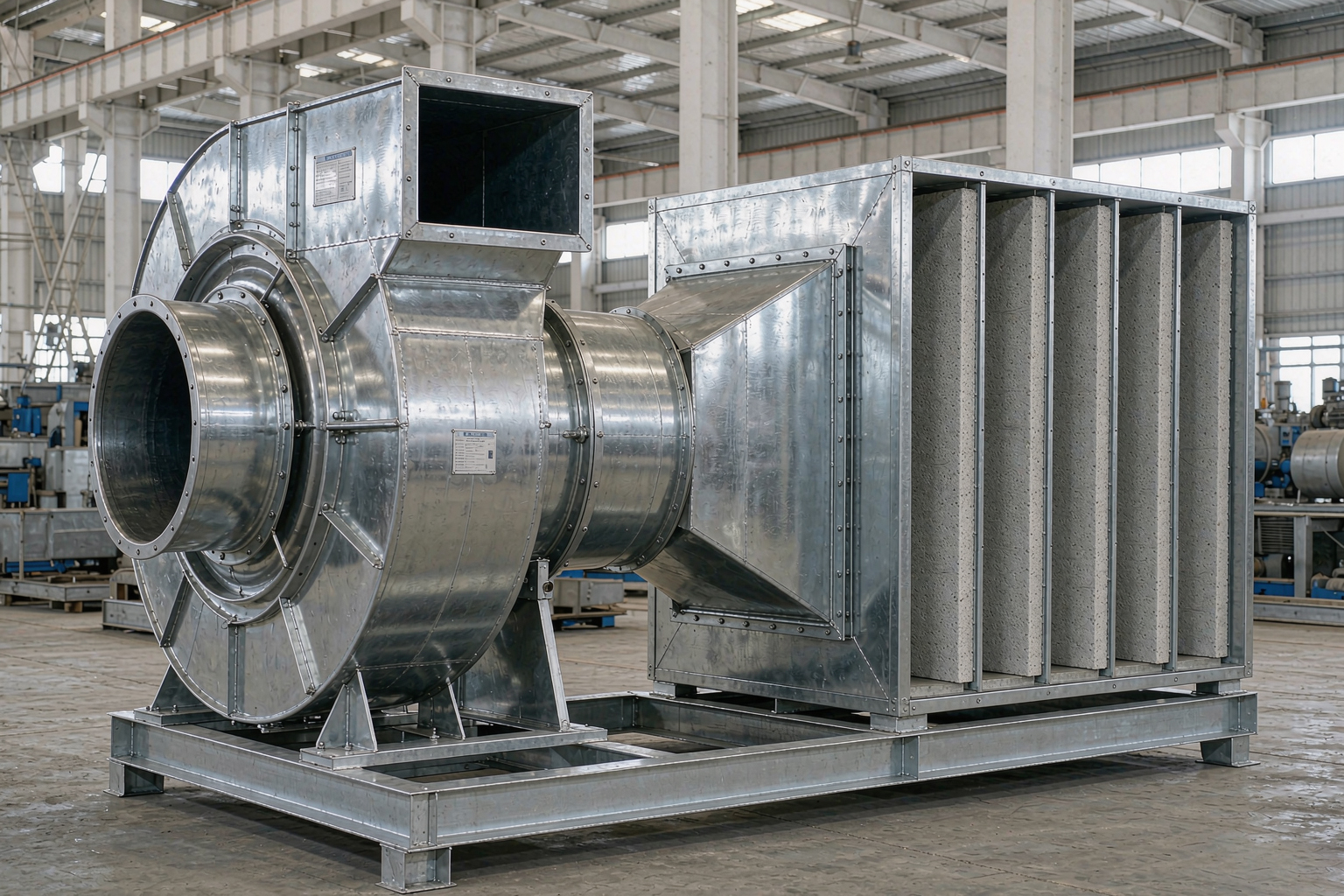
Conclusion first. When the workshop fans start, the office block two streets away hears it — fan noise is the most common industrial complaint there is, and the fan silencer is the "noise valve" mounted right at the intake or discharge to stop it. But a silencer is not a simple pipe fitting: it consumes fan pressure, and a wrong selection does not merely fail to silence — it pulls the fan off its duty point, drops the airflow, shifts the motor current, and the original ventilation design quietly stops being met. HANWEI silencers are sized on three books at once. Book one, airflow: the free area is set so channel velocity lands in the optimal 8–12 m/s band. Book two, pressure: total loss is held ≤30 Pa at rated flow, inside the fan's static margin, with measured data shipped with every unit. Book three, spectrum: the internal structure is matched to the measured noise — absorptive splitters of 80 mm centrifugal glass wool (48 kg/m³, NRC ≥ 0.85, perforated facing plus glass-cloth anti-blow lining) take the mid–high frequencies, while resonance and expansion chambers add 5–10 dB in the 125–250 Hz band, for a dynamic insertion loss of 15–30 dB(A). Send the fan model, flow, total pressure and spectrum; the selection scheme comes back the same day.
Dissipative, reactive, combined — the spectrum decides, not habit. The fan's noise spectrum dictates the internal structure. Centrifugal fans radiate mostly mid–high frequencies (blade-pass and turbulence), where rectangular splitter silencers are the best value: parallel splitters slice the channel into narrow passages and the wool absorbs at every pass, with small pressure loss. Axial fans move large flows at higher velocity through round ducts — a cylindrical silencer with lined walls avoids choking the flow. Roots blowers are the classic low-frequency case: low speed and strong pulsation put the peak at 125–250 Hz, where purely dissipative splitters manage barely 5 dB — only a combined impedance type works, reactive chambers reflecting and cancelling the low frequencies before the dissipative section cleans up the remainder. The classic error is one silencer type for every fan: a roots blower with a dissipative unit loses 15 dB of hiss while the 250 Hz drone walks straight through, and to the owner "it does not work". We configure to the measured spectrum, estimate it from type and speed when no measurement exists, and state the expected insertion loss per band in the proposal — acceptance is on the same 1/3-octave basis.
Pressure loss: the page this industry loves to hide. Everyone quotes an insertion-loss figure; pressure loss is the line that goes "missing" from the quotation. The damage is deferred: excess back-pressure walks the fan up its curve, airflow falls, motor power shifts, and the workshop runs hot or the boiler starves — and the investigation ends at the silencer. So the pressure numbers go in writing: ≤30 Pa at rated flow, measured report attached; splitter channels designed to the optimal velocity band rather than narrowed to squeeze in more wool; transitions flared to suppress turbulence, because a silencer must not become a new noise source — above 15 m/s the regenerated noise of the air itself eats the attenuation, and that is the most common selection trap of all.
Field lessons. Insertion loss without spectrum: a wastewater plant bought "25 dB" dissipative silencers for its roots blowers and the complaints stayed — the noise peak sat at 250 Hz where the splitters manage 5 dB. Swapping to combined impedance types added 12 dB in the low band and the night-time boundary finally passed. Wool blown out: three years after installation, one client's silencers had lost their fill — high-velocity air had carried the glass wool out through over-perforated facings with no cloth lining. Our splitters use perforated facing plus hydrophobic glass cloth, add steel mesh at high velocity, and the inspection pull-out shows intact layers years later. Vibration through the frame: a silencer hard-flanged to the fan conducts structure-borne noise down the whole duct run — the air path is silenced while the solid path sings. Flexible connectors at the flanges and anti-vibration hangers under the silencer are now standard, closing both paths in one visit.
Intake or discharge? Position changes the structure. The two ends of the same fan often need different silencers. The discharge side is the main outlet of noise and takes the full-insertion-loss unit; the intake side is equally loud but far more sensitive to restriction — every bit of suction loss pulls the fan performance down, so the intake silencer gains a size of free area before it gains wool. One boiler house learned this the hard way: an undersized intake silencer starved the combustion air until the unit was upsized one flange and the splitter pitch widened. Whether to silence both ends or one is decided by measurement, not habit — and where several fans share a common header, cross-talk must be blocked: idle branches need back-draft splitters or branch silencers, or the running fan broadcasts out of every unused opening.
Verification and supply. Four checks before signing: demand measured pressure-loss data at rated flow (no-loss-figure schemes are eliminated on sight); require band-by-band expected insertion loss against the fan spectrum — a single grand "25 dB" cannot survive acceptance; pull a splitter and inspect the anti-blow construction (perforated facing, glass cloth, steel mesh at high velocity); and match flanges to standard with flexible connectors — forced transitions create eddy noise and their own pressure loss. Production runs 10–20 days: shells folded and welded, splitters filled and faced on the line, pressure-loss report per unit. Installation uses flexible connections and anti-vibration supports, orientation and slope per drawing, and acceptance closes with 1/3-octave insertion loss, an airflow re-check and a pressure-loss re-measurement — the report delivered with the silencer.