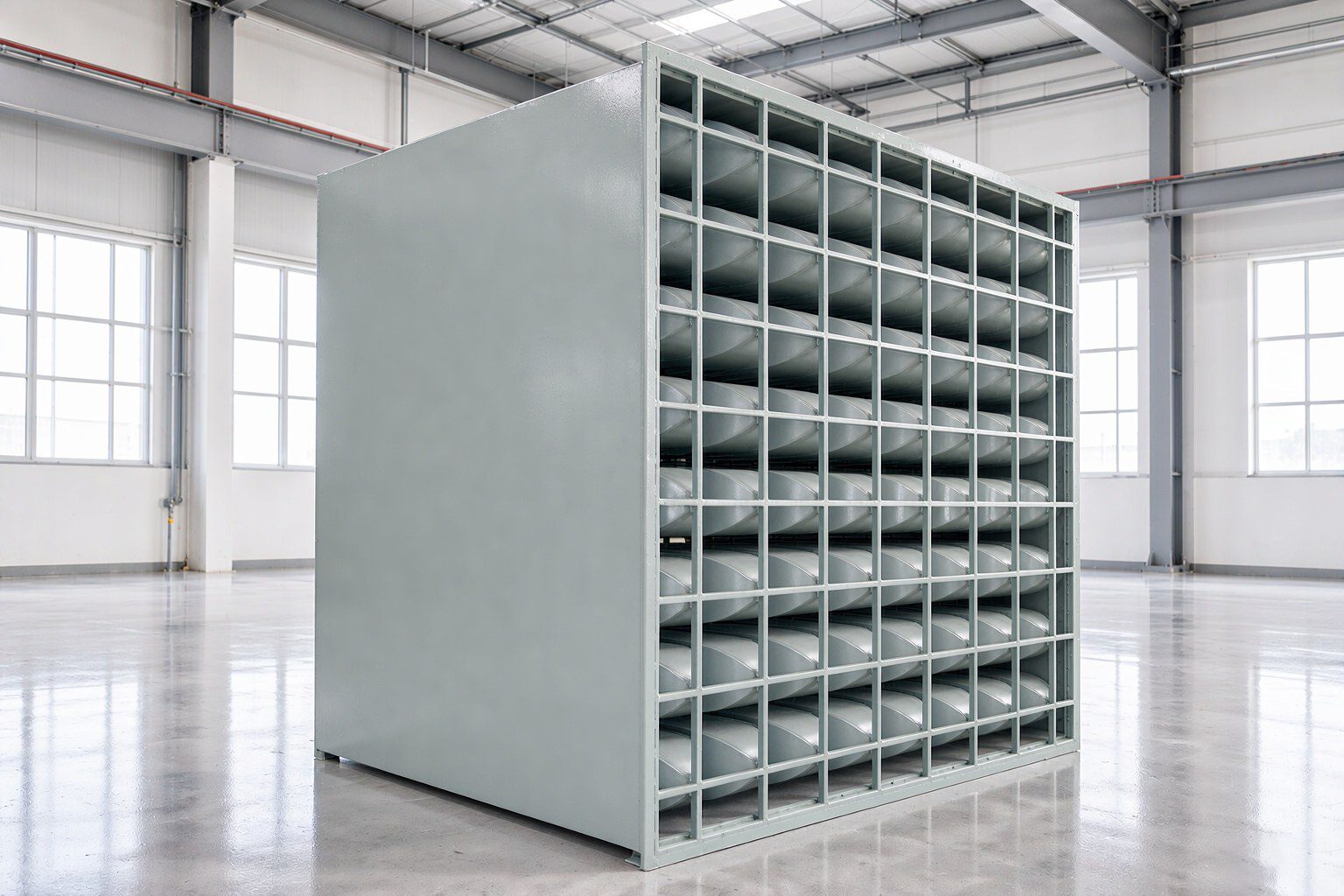
Matrix Silencer: The "Low-Resistance" Solution for High Airflow Applications
Cooling tower discharge openings, machinery room intake faces, large duct outlets — what these scenarios share is a common challenge:high airflow volume, wide cross-sections, and the need to keep pressure drop within a minimal margin. Conventional panel silencers divide the duct into narrow sound-absorbing channels; when airflow increases, you either stack more panels until the housing becomes enormous, or the face velocity rises and pressure loss exceeds limits. The matrix silencer takes a different approach: instead of placing parallel flat panels inside the housing, it arranges streamlined (spindle-shaped) sound-absorbing elements in a matrix layout — each element absorbs sound independently, and all gaps between elements are effective free-flow areas. Sound waves enter the array from the grille face and repeatedly diffract through the channels between elements, being absorbed layer by layer by perforated-surface-protected acoustic cotton (cotton density 48 kg/m³, NRC ≥ 0.85), achieving 15–25 dB of attenuation; meanwhile, air flows smoothly along the streamlined surfaces of the elements — led at the head and tapered at the tail — generating virtually no turbulence, with pressure drop ≤ 25 Pa.Noise reduction comes from the array's "density"; low resistance comes from the elements' "aerodynamic shape" — both achieved simultaneously within the matrix structure. This is why it holds up in applications like cooling towers, where both noise and airflow loss are critical concerns. Send us your airflow, allowable pressure drop, and noise targets, and we'll provide a selection proposal the same day. Call 18831881133.
Streamlined Elements: Two Layers of Design Inside a "Bullet Nose"
The spindle shape is not an aesthetic choice — it is driven by dual aerodynamic and acoustic requirements.Aerodynamically: when airflow hits a blunt body, flow separation generates vortices, which are themselves sources of regenerated noise and consume static pressure. The element head features a smooth导流 curve so that airflow stays attached across the entire surface and recombines at the tail, minimizing both regenerated noise and pressure loss.Acoustically: the element's cross-section varies continuously along its axis, creating a gradual impedance transition from the grille face to the core. Sound waves are not harshly reflected at material interfaces but are guided into the element interior and dissipated layer by layer — the same principle as hole-jet and wedge "impedance grading," only applied along the horizontal axis. The element's protective facing uses a double-layer cover of perforated plate plus fiberglass cloth: the perforation rate is designed for acoustic impedance matching, protecting the cotton while allowing sound to pass through. Cotton fill density is calibrated segment by segment to ensure consistent performance across every element — every element in the array is a link in the chain; inconsistent elements will degrade the entire array's performance.
Pressure Drop and Maintenance: Two Often-Overlooked Accounts
For matrix silencer selection, both the pressure-drop account and the maintenance account must be settled during the proposal phase.Pressure-drop account: face velocity is the master variable. For the same airflow, enlarging the housing by one size tier reduces velocity, and pressure drop drops by the square. A smaller housing may save upfront cost, but the extra fan energy consumption will eat that savings back year after year. Our principle is to balance all three accounts — airflow, pressure drop, and sound attenuation — together: first determine how much pressure drop budget the system allocates to the silencer, then derive the required face area accordingly. Attenuation is adjusted by varying the element spacing density, not by sacrificing free-flow area.Maintenance account: elements are consumable components — the fiberglass cotton facing will degrade over years of high-velocity operation. Our elements use a slide-in installation design: the front grille frame is opening-accessible, allowing individual elements to be pulled out for inspection or replacement without dismantling the housing. Some manufacturers weld elements in place permanently; once the cotton powders, the entire unit must be cut out and replaced — the matrix structure may cost slightly more upfront, but the savings become clear during maintenance.
Project Lessons: Three Things We've Learned About Matrix Silencers
Don't compare attenuation alone without comparing free-flow area. At a data center intake, two bidders offered the same 20 dB attenuation, but the winner's housing was 30% smaller. After installation, airflow dropped, forcing the fans to speed up — and noise actually got worse. Free-flow area and effective travel length are the core parameters of a matrix silencer; attenuation numbers without airflow and pressure-drop context are meaningless.
Loose element fixation leads to detachment under operation. In one project, elements were fixed at only four corner weld points. Under high-flow pulsating airflow, the elements resonated and loosened — two broke free and damaged downstream equipment. Our elements are fully welded around all four sides plus mechanically clamped, and the grille frame is doubly verified against wind load and pulsating load.
露天安装无防雨措施,棉芯一个冬天吸潮板结。 At a cooling tower roof, the intake silencer faced upward with no rain protection. Rainwater entered the elements, the cotton core absorbed moisture and consolidated, and sound attenuation performance dropped by more than half. Outdoor installations require a rain canopy and water-diverting eaves, plus a hydrophobic membrane on the element facing — the deployment plan must clarify whether the unit is installed indoors or outdoors from the start.
How to Choose Between Matrix, Panel, and Cylindrical Types: One Mouth, One Application
Matrix type excels in large cross-section, low-resistance applications: cooling towers, machinery room intake/exhaust faces, and duct outlets — those "wall-sized openings" where a matrix array can cover the full cross-section without blocking airflow.Panel type wins on simplicity and low cost: the most cost-effective choice for straight duct sections inside rectangular ducts.Cylindrical (round duct) type wins on installation convenience: small-airflow duct connections can be spliced directly into the pipeline. The dividing line among the three is cross-section size and pressure-drop margin: for cross-sections exceeding 2 m × 2 m with tight pressure-drop budgets, go matrix; for standard ducts with ample pressure-drop margin, panel is sufficient; for duct interfaces under DN1000, cylindrical is the simplest. If you're unsure which type to choose, send us your system drawing and we'll provide comparative parameters for all three configurations — let the data speak for the solution.
Scenario Quick Reference: Matching Four Application Types
Cooling tower intake/exhaust: fan noise叠加 with splash noise, large facing area, sensitivity to airflow loss — matrix type is the primary choice, with rain canopy and flow-directing section on the open face.Machinery room intake/exhaust faces (data centers, switchrooms): large wall-area intakes where the matrix array covers the full cross-section, with element density tuned to the frequency spectrum.Large duct outlets: industrial plant main exhaust, flange-to-housing connection, custom module sizes based on airflow.Basement/tunnel ventilation openings: high-velocity axial fan applications with denser element layout and导流 inlet. The common thread across all four scenarios: verify airflow and pressure-drop margin first, then determine housing cross-section and element layout — the order cannot be reversed.
Purchasing Checklist: Four Verification Steps for Matrix Silencer Proposals
1. Verify effective free-flow area. Require the bidder to state clearly the housing cross-section dimensions and the blockage ratio occupied by elements — a proposal with insufficient free-flow area will become an airflow failure after installation.
2. Inspect element fixation and maintenance structure. Any proposal using point-welded, non-removable elements should be eliminated outright — half the value of a matrix silencer lies in its serviceability; the maintenance structure determines its condition five years down the line.
3. Request dynamic attenuation and pressure-drop test data. Static lab data and on-site performance are two different things. Verify against dynamic test data at rated airflow, and include pressure-drop commitments in the contract.
4. Verify rain protection for outdoor installations. Confirm that rain canopy, water-diverting eaves, and hydrophobic membrane are all included — once the cotton core absorbs moisture and consolidates, performance drops by more than half, and the cost of rework far exceeds the upfront investment in proper configuration.
Supply and Installation Process
1. Selection & Calculation: collect airflow, allowable pressure drop, noise target, and installation cross-section (duct flange or open face) in one go;
2. Proposal & Quotation: housing segmentation and element layout drawing, dynamic attenuation and pressure-drop commitment, rain protection configuration list — itemized quotation provided the same day;
3. Detailed Design: grille frame nodes, element slide-in tracks, rain canopy and water-diverting eaves, flange mating drawings;
4. Manufacturing: element pressing and wrapping, housing bending and welding with powder coating, frame leveling; dynamic test report included with each shipment;
5. On-site Installation: housing positioning and leveling, flange connection or open-face fixing, element insertion and locking, rain protection assembly;
6. Acceptance: dynamic attenuation and pressure-drop measurement (1/3-octave band) + element slide-in inspection, report delivered with documentation.