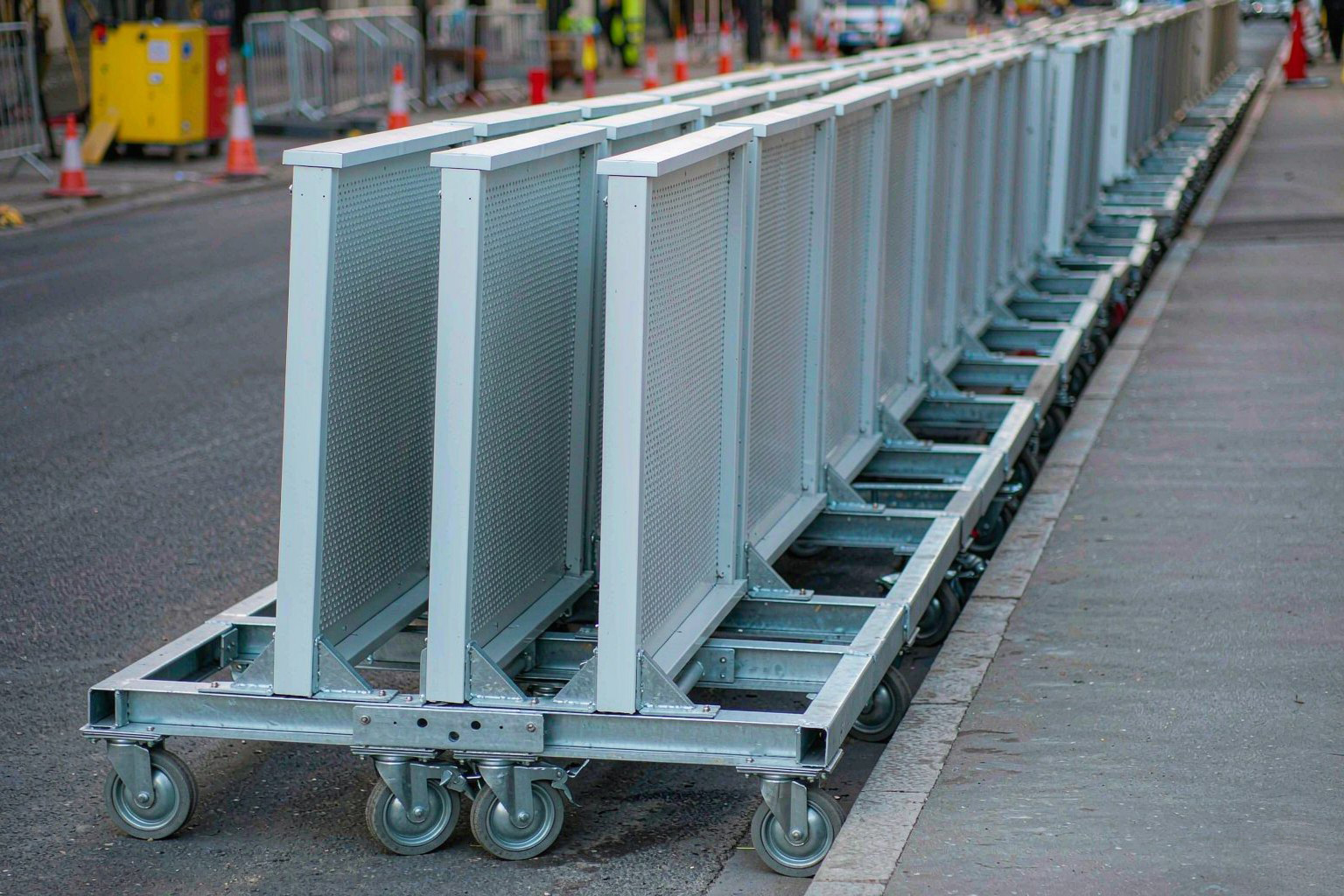
Mobile Sound Barriers: Where the Noise Moves, the Barrier Follows
Midnight municipal pipeline emergencies, overnight concrete pours, rotating equipment maintenance at pump stations—these noise operations share two defining traits:you move on as soon as the job is done, and complaints arrive fast. Fixed barriers can't be constructed in time, and standard construction hoardings don't stop sound. What the crew really needs is an acoustic wall that moves with the project. That's exactly what our mobile sound barrier does: each module is a complete sound-absorbing/insulating panel (perforated absorptive face + 80 mm centrifugal glass wool core + sound-insulating backing panel, wool density 48 kg/m³, NRC ≥ 0.85), slotted into a galvanized steel base on swivel casters, with modules pinned together at the joints. Push it wherever you need to围—two or three workers can assemble a continuous 50 m wall in about half an hour, then dismantle, load, and relocate to the next site. Hanwei Sound Insulation & Noise Reduction designs each solution around three priorities simultaneously: target noise reduction, placement layout, and turnover efficiency. We calculate the required wall length and enclosure angle based on the作业 noise level and distance to sensitive receptors, then select swivel casters or stabilizing outrigger legs according to the site ground conditions. Send us the作业 type and a site floor plan, and we'll deliver a placement proposal the same day. Call 18831881133.
Joint Sealing: The Weakest Link in Mobile Barriers
Many assume mobile barriers are merely "visual screens that provide psychological comfort." The real problem lies in the seams between modules.A barrier's noise reduction rating applies to the wall as a whole—just one 2 mm straight gap along the seam is equivalent to opening a hole in the wall. With ten modules forming a wall, there are nine joints; if every seam leaks, the overall performance drops to single digits. Our modules feature male-female tongue-and-groove side joints, and after the pins are locked, a triple EPDM rubber sealing strip is compressed into place, making the acoustic continuity at the seam nearly equivalent to a solid panel. The bottom edge presses against the ground via adjustable leveling legs, and where the ground is uneven, rubber sealing pads fill the remaining gaps. Another frequently overlooked leakage path isthe openings at both ends of the wall where it meets fixed structures: a 50 m wall with a 2 m gap at each end beside a building wall lets sound simply wrap around. The placement plan must address end sealing from the start—if the wall can't接 to an existing structure, use corner end-cap units. During acceptance testing, we verify performance against the GB 12523 site boundary noise standard through on-site measurements, ensuring the assembled wall lives up to the laboratory data.
Base & Stability: A Wall on Wheels—Wind Comes First, Then People
A three-meter-tall wall on casters raises one primary safety question:stability is the first design priority. The mobile barrier's structural integrity is verified against two load cases. First, wind load—outdoor installations present a large windward area, and the pressure from a Force 8 wind is enough to topple an unballasted barrier. We equip each unit with spiral anchoring legs that bear directly on the ground, and the base frame includes a dedicated ballast compartment. For extended outdoor use, ballast is mandatory. Second, operational loads—pile drivers, vibrators, and similar equipment operating alongside the barrier generate sustained lateral forces that the locked legs and base self-weight must resist. We specify heavy-duty swivel casters with brakes, sized at 1.5 × the fully loaded unit weight per wheel. During relocation, the brakes are released and the unit is pushed; once in position, wheel brakes plus outrigger legs provide dual锁定. A common industry cautionary tale: some manufacturers thin the base frame to save weight, and under wind the entire row collapses like dominoes—damaging vehicles and endangering people. Mobility is mobility, but safety margins are non-negotiable. Our base frames are integrally welded from hot-dip galvanized steel sections, designed for a service life of five years or more of repeated cycling.
How to Determine Height: Taller Is Not Always Better
Barrier height directly affects performance, but the relationship is not linear:a barrier works by blocking the line of sight between the noise source and the sensitive receptor. Sound primarily diffracts over the top edge—if the line of sight is blocked, a sound shadow zone forms; if not, the barrier relies entirely on its mass and insulation to hold back noise. For low作业 surfaces (ground-level breaking, cutting), a 2.5 m barrier creates an effective sound shadow zone covering receptors 20–50 m away. When the noise source is elevated (excavator arms, pump truck booms), the wall must be raised above 3 m, or the placement distance increased to change the interception angle. Blindly increasing height carries three penalties: wind load scales linearly with windward area, requiring proportionally more ballast; relocation becomes harder as heavier units exceed what two people can push; and visual obstruction creates traffic and safety management issues, especially at municipal intersections where driver sightlines matter. Our guidance is straightforward: calculate the required sound shadow zone first, and the minimum height that achieves it is the optimal height. Any shortfall in dB is better addressed through optimized enclosure angles and end sealing than by simply adding height.
Scenario Quick-Reference: Layout Strategies for Four Temporary Noise Types
Municipal Road Construction (overnight asphalt paving, breaking): Single-row straight layout along the side facing sensitive receptors, 2.5–3 m height, with end sealing to fixed structures.Construction Sites (overnight pouring, street-facing tower cranes): Combine with existing construction hoarding as a "hoarding + mobile barrier" heightened system, prioritizing the segment directly facing residential areas.Pump Stations / Machine Room Maintenance: Semi-enclose the作业 unit in a U-shaped layout with the opening facing away from sensitive receptors, gaining roughly 3 dB more reduction than a single-row straight wall.Performing Arts Events / Sports Venues:围 the stage and sound system area with corner end-cap units, preserving audience sightlines. The common thread across all four scenarios: placement geometry determines performance; wall height and length are secondary—theangle of enclosure is what matters most.
Procurement Checklist: Four Verification Steps for Mobile Barrier Solutions
1. Ask about the joint sealing method. Any proposal that quotes only individual panel noise reduction ratings without addressing seam sealing should be eliminated outright—the field performance belongs to the continuous wall, not to isolated panels.
2. Verify the base frame and ballast configuration. Require the supplier to provide wind-load calculations and ballast specifications. Products without outrigger legs and ballast compartments are a safety hazard in open-air conditions.
3. Request a live turnover demonstration. Demand that the supplier show two workers pushing a single module and assembling 50 linear meters within thirty minutes—turnover efficiency is the core value proposition of a mobile barrier. Anything slower is effectively a fixed screen in disguise.
Supply & Installation Process
1. Solution Design: collect作业 type, noise level, sensitive receptor distribution, site plan, and ground conditions in one go;
2. Placement Layout & Quotation: deliver a placement schematic (enclosure angle, wall length, end sealing), same-day turnaround;
3. Detailed Configuration: panel height modules, caster and outrigger selection, ballast block schedule, corner end-cap units;
4. Production: core material filling and compression, base frame welding and hot-dip galvanizing, caster and leg assembly, pre-assembly verification before shipment;
5. On-Site Assembly: transport to site, crane-lift modules into position, pin joints and compress seals, level and lock outrigger legs;
6. Acceptance: on-site noise measurement against GB 12523 limits, seam seal inspection, turnover操作 handover briefing.